Happy June 16th, Baboons! It is Bloomsday, the day that Ulysses was set. I have to admit I read that book several decades ago and couldn’t make sense of it. I am tempted to reread it now, as I think I have some added maturity to “get” what Joyce was trying to say. We will have to see about that. It may be as incomprehensible as it was the first time I tried to read it in my 20’s. I have really enjoyed hearing recitations of Ulysses on Bloomsday, as it seems to be more accessible when it is read aloud.
What are your experiences with James Joyce’s works? What do you reread?
On this day in 1752, Benjamin Franklin conducted his experiment with electricity and the kite. He invented the lightening rod.
I never could understand why my cousin Carol and and her husband had all theses lightening rods on the roof of their very old farm house in Pipestone County. Why would you want to attract lightening?
I avoided hard science classes in High School and college at all costs. Now, I regret it. I wish I knew more of Physics. I think Physics is a way to understand God. What a coward I was!
What are you experiences in science classes? What about kites?
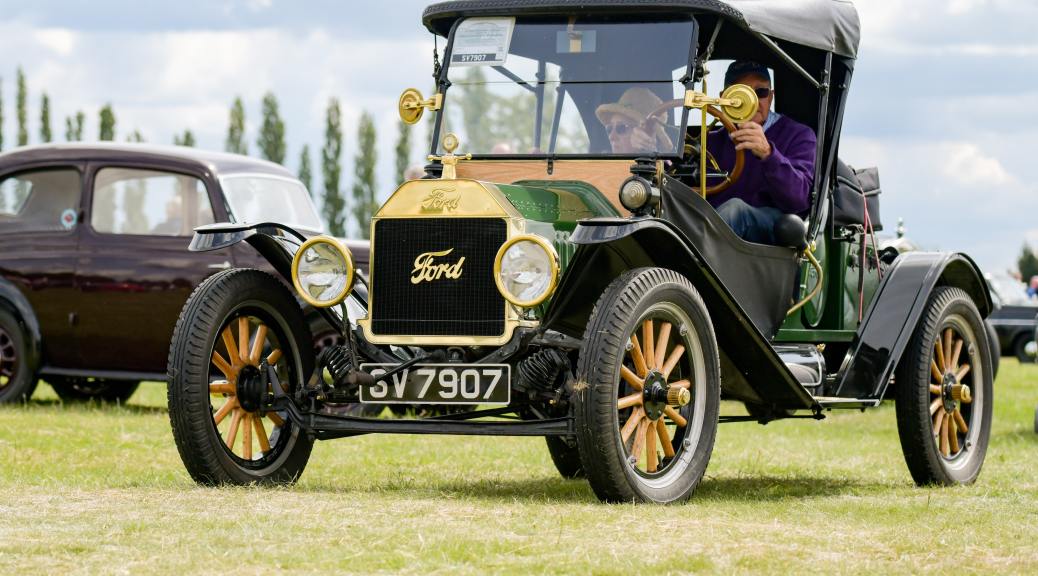
On this day in 1896, Henry Ford drove his first Ford through the streets of Detroit. I can only imagine what people thought when they saw it. I wonder what the horses in the city did and thought when they saw it.
My first car after I got my license was a little Nash Rambler that was missing the pedal on the foot feed, so I had to press my foot on the metal bar the foot feed would have been attached to had it been there. My first real car was a Chevy Chevette that my parents got for me when I was in college. Now we drive a Honda van and a Toyota pickup. My father loved to buy and sell cars, and the last car he bought was a Subaru when he was 93. He said it was the nicest car he ever had. I am glad he got a chance to drive it.
What was your first vehicle? Do you have any vehicular prejudices?
Can we talk about television? Since I live under conditions I call “house arrest,” almost never setting foot outside my apartment, I get to watch a lot of TV.
It wasn’t always like that. When broadcast television first entered my family’s home, programming was limited and boring. By “limited” I mean we had one channel at first, and it ran programs only up until midnight. By “boring” I mean amateurish. Most of those early programs were forgettable. We had better things to do than sitting around looking at that stuff.
In the 70s it was fashionable to call that appliance the “boob tube.” People pretended they never watched it, but if you mentioned a particular show, they suddenly could describe plot developments with loving detail. They obviously watched more than they cared to admit.
Even so, I watched very little in the 60s and 70s except newscasts and a handful of weekly shows. When we bought our first home, the TV sat in the basement. It wasn’t important enough to occupy space upstairs.
Now, between the limits imposed by old age and the new limits imposed by COVID-19, I watch a lot. Some critics claim we are living in a golden age of wonderful programming. Maybe they have access to channels I can’t afford to watch. I’m a Netflix subscriber. They sure have many offerings, but I have to start a dozen Netflix shows before finding one I can commit to. Cable television seems a wasteland of so-called “reality shows.” PBS has some good programs (when it isn’t running pledge drives).
How about you? Watching much these days? Any shows you want to recommend? Any shows that are so disgusting you want to call them out? There are commercials, quite a few, actually, that send me rushing to push the Mute button. Are there any commercials you hope to never see again?
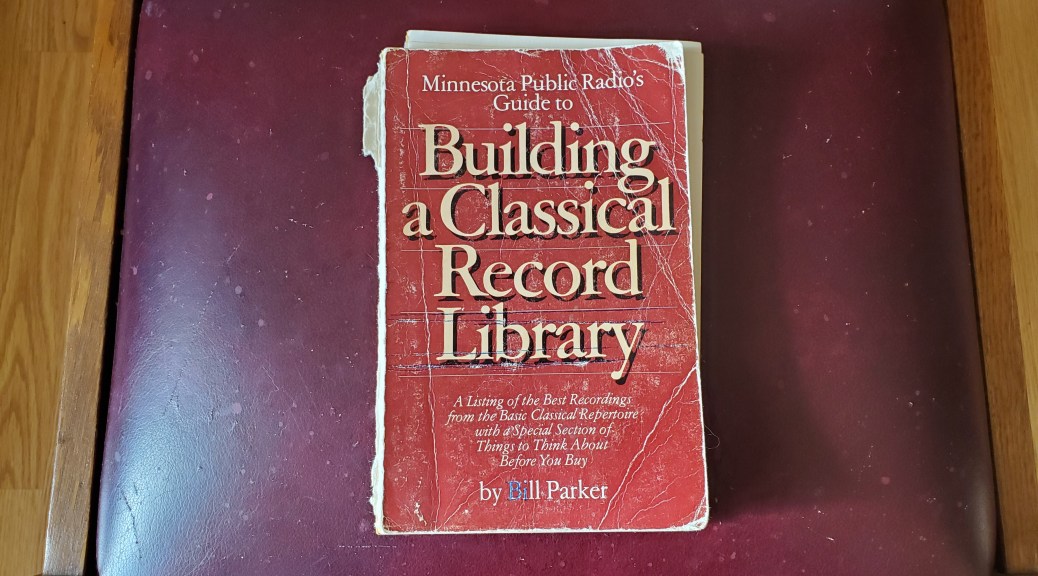
In the early 1980’s, I was a budding classical music audiophile who lived on a graduate student income. Winnipeg had a number of good record stores for classical music albums, and I wanted to make sure that I got the best albums for my measly disposable income. I was able to do that with a handy dandy guide courtesy of MPR and Mr. Bill Parker with Building a Classical Music Library. It was very helpful identifying good recordings and performers.
I hadn’t thought about this book for quite a while until Thursday night, when Husband brought it up out of the basement as we were trying to figure out what was so important about our vinyl recording from 1981 of Vladimir Ashkenazy’s piano version of Pictures at an Exhibition. Paging through the book, I realized how many treasured recordings we have that Mr Parker suggested.
One favorite recording from that period of my life is that of Percy Grainger playing Grieg’s A minor Piano Concerto. Grainger was long dead by the time of the recording. He made piano rolls of the concerto in the 1920’s, and a piano set up to play the rolls was recorded with the Sydney Symphony. Here is the same set up with Andrew Davis conducting at the London Proms in 1988.
Today marks the anniversary of two important milestones in the history of the Blues- the birth in 1896 of the Reverend Gary Davis, and the death in 1983 of Muddy Waters. I never really listened to the Blues until I met Husband. One of our first dates was at a concert by James Cotton at the University of Manitoba.
Here is the Reverend Davis:
And here is Muddy Waters. (Husband’s suggestion)
Here, too, is Leadbelly, just because it is a Blues number I have always liked.
The things he sings about going on in Washington, DC are still happening!
Here are the lyrics in case it is hard to understand.
Lord, in a bourgeois town
It’s a bourgeois town
I got the bourgeois blues
Gonna spread the news all around
Home of the brave, land of the free
I don’t wanna be mistreated by no bourgeoisie
Lord, in a bourgeois town
Uhm, the bourgeois town
I got the bourgeois blues
Gonna spread the news all around
Well, me and my wife we were standing upstairs
We heard the white man say “I don’t want no niggers up there”
Lord, in a bourgeois town
Uhm, bourgeois town
I got the bourgeois blues
Gonna spread the news all around
Well, them white folks in Washington they know how
To call a colored man a nigger just to see him bow
Lord, it’s a bourgeois town
Uhm, the bourgeois town
I got the bourgeois blues
Gonna spread the news all around
I tell all the colored folks to listen to me
Don’t try to find you no home in Washington, DC
‘Cause it’s a bourgeois town
Uhm, the bourgeois town
I got the bourgeois blues
Gonna spread the news all around
What are your favorite Blues numbers? Got any good Blues lyrics for Baboons this week?
Happy Leap Day! My cousin Duane was born on Leap Day. He got his picture in the Pipestone, MN newspaper when he was 4 because he finally had an actual birthday to celebrate.
Starting in Ireland centuries ago, then spreading across Europe, Leap Day was the day every four years when women could propose to men. In Scotland, the woman had to wear a red skirt when she proposed. There were penalties if the men refused. In some places, the man had to purchase twelve pairs of gloves for the woman. In Finland, he had to give her enough cloth to make a skirt. Currently in France, La Bougie du Sapeur, a satirical magazine, only publishes on Leap Day.
I was fascinated to read that during 1930 and 1931, the Soviet government added February 30th to the calendar and made all the other months have 30 days so that all the weeks of the year could have 5 days. I don’t know why they dropped the plan.
How would like to see Leap Day celebrated? How would you change the calendar if you could?
This is probably petty, but I have decided that I will never again eat shrimp. I made a similar declaration about carrots when I was so short that I could walk under the kitchen table without stooping. I remember it with absolute clarity. I was standing under the kitchen table, facing the east wall of the kitchen which bordered on the back yard, when I made the decision. I must have been 2 or 3 years old. I remember saying to myself “I’m not going to eat carrots anymore.”. There was no precipitating event. I just decided that I and cooked carrots would part ways. I think I was just exercising autonomy and independence at the time, and I remember refusing cooked carrots for many years. Then, sometime in Grade 2 I just decided to eat them again. I was fortunate that no one ever insisted that I eat anything I didn’t want to eat, and I was encouraged to cook for myself at an early age. I love cooked carrots now.
I dislike the taste, texture, smell, and harvesting practices of shrimp, especially the harvesting practices. They are so destructive to the environment. Most people I know love shrimp, but I do not. I do not think I will change my mind about this. There many other fish in the sea.
What are some irrevocable decisions you have made? What moratoriums have you declared? What fish do you like or not like.
Well, today is Valentine’s Day. Husband is on the Rez and will return tonight. We have never really celebrated this day much, as I will get flowers and chocolates for myself anytime I want them, and I don’t expect my stressed and overworked spouse to get them for me. He says he always feels spoiled and catered to by me, so he has no expectations for me today, either.
When I think of this day, I think of Al Capone, the St. Valentine’s Day Massacre, and a guy named A. Claire Dispenet (Ace), the Francophone owner of the original Magnolia Bar and Steak House in Magnolia, MN. Magnolia is about 6 miles east of Luverne. My dad grew up there. Claire had a rather shady history as a bootlegger in the 1920’s. My dad worked for Claire as a bartender in the 1950’s before he built his gas station and coffee shop. During Prohibition, Claire drove a beer truck on Minnesota’s North Shore for the Capone organization. His beer truck was stolen, and Claire had to phone Chicago to relate the news. He was told to not worry about it, and that they knew who the guys were who stole the truck, and that “We will take care of them”. Claire knew what that meant, and decided then and there and seek employment elsewhere. He didn’t want to be involved in a murder. He ended up serving time in Ft. Leavenworth Prison for bootlegging sometime after that, though. My dad really liked him. Ace, as he was affectionately called, was a character. His wife was a very devout Catholic and made sure he was buried as close as possible to the grave of the former priest in the Luverne Catholic Cemetery. Dad said she hoped Ace could grab onto the Priest’s robes and sneak into heaven behind him.
How do you celebrate Valentine’s Day now. What are your memories of this day from elementary school?
On February 5, 1967, the Smothers Brothers Comedy Hour premiered on CBS. I remember watching it, as well as Laugh In, Carol Burnett, Jackie Gleason, Jonathan Winters, Jack Benny, and Red Skelton.
I was only 9 years old at the time, and sometimes I just didn’t get the humor.
I think I liked Carol Burnett the best.
It was such an unhappy time, the late 60’s, yet such shows proliferated. One thing that surprised me as I researched this was how long the sketches were that I found.
What was your favorite comedy show? Know any good jokes?







 Trail Baboon