Category Archives: Stories

Out & About

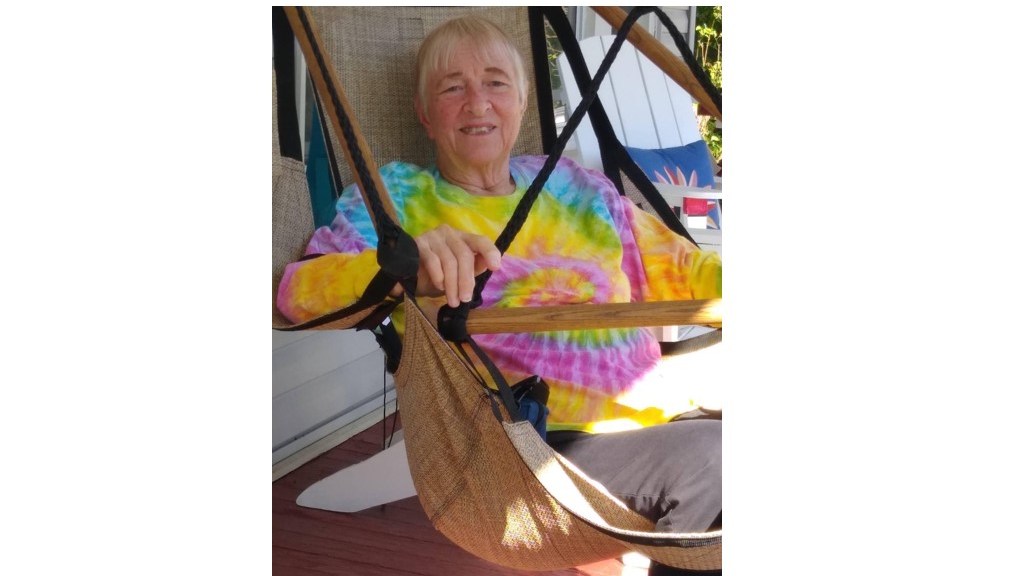
The home health care team was pretty adamant that Nonny not go out while she is “convalescing”.  She got permission for church and for her weekly shampoo and blow out.  (While I was there, she also convinced them that she should be allowed to go to a 90s birthday party with her PEO group, where she is one of the honorees.  She shamelessly used tears to get this dispensation.)

Wednesday morning, we got her out of the condo, down the steps and into the car.  Her walker folds up easily so we were quickly on our way.  The hairdresser is in a neighborhood called Old Orchard, which is located in Webster Groves but actually was around before it was swallowed up by Webster.  When I was in the 5th grade, we moved to Old Orchard – we lived in the house on Sunnyside for five years – the longest of any of the houses I lived in until I was on my own.    Since we were right there, we drove over to see how the house was doing.  It looks just fine, although it’s white now; when we lived there my folks had it painted a deep gray and we had yellow trim.  Then we went a saw my grandparents house which is 2 blocks away (they lived there before we lived on Sunnyside).  Then we went looking for the elementary school I went to in 5th and 6th grade.  We didn’t find it and an internet search shows when it was built and when it changed names but nothing about when it closed.  I’m just curious enough that I might call the school district in the next couple of weeks and ask them.

By this time, we were on a roll.  We found 2 of the schools Nonny went to as a kid, the house she lived in back then and then rounded off our trip down memory lane by driving  by the house on West Cedar where we lived when I was five. 

I learned to ride a bike when we lived here.  Nonny had scarlet fever when we lived her.  I played with Bobby and his matchbox cars and was just about to go into kindergarten at Bristol school when my dad got a job with Missouri State and we moved to Jefferson City. 

When my sister Sally came over later on Wednesday, we regaled her with all the places of our past that we had visited.  She was quite upset as apparently the permission to get Nonny’s hair done did not include joy-riding.  In fact, the home health care team had specifically said Nonny shouldn’t be accompanying anyone on any other trips than her allowable outings.  Oops.

Neither Nonny or I mentioned our gadding about when the physical therapist came the next day.

When was the last time you went joy-riding?

I Missed It

Boris Johnson resigned?  When the heck did that happen?

I know I’m not thrilled reading the news these days but I do check in every few days.  Yesterday I saw a couple of things on Facebook that drove me to CNN.  Lots of news about the Prime Minister Shinzo Abe’s assassination but nothing about Boris.  So I thought I’d check out BBC.com.  Absolutely nothing.  Thinking it was a fool’s errand, I just typed “Boris Johnson” into Google and finally found the news.  Seems as if four days later, it isn’t a headline any longer.  Like you shouldn’t blink or you’ll miss big chunks of what’s happening in the world.

The year after I graduated from high school, I spent 8 weeks living with a family in Mexico (their 2 daughters had spent the summer with us the year before).  Back then – yes, when dinosaurs roamed the planet – no BBC.com, no CNN.com, no streaming.  Just the daily newspaper, which in that corner of Mexico really did not carry any international news at all.  I felt a little cut off from the rest of the world while I was there – I’m assuming it’s how those bio-dome folks must have felt.

I came home from Mexico on a bus through Nogales to Albuquerque – stayed in a hotel one night and then flew home the next day.  That morning in Albuquerque I took a long walk and before returning to the hotel, I stopped at the corner drugstore and bought copies of several news magazines (Time, US News & World Report, Newsweek, even the Atlantic Monthly).

Apparently while I was in Mexico, there was a problem between Greece, Turkey and Cyprus.  Despite having the top news magazines of the day in my hands, I couldn’t really figure out what had happened.  If you don’t read the first news stories, it’s hard to “catch up”.  To this day, I’m not really 100% sure exactly how it all played out although I know that Cyprus is divided by a Green Line with the Greeks in the south and the Turkish in the north. 

I’m a little worried that this is how it will be for me and Boris Johnson.  I’ve found a few op eds and I THINK I’ve got it down, but am still a little surprised at how fast the story came and then went!

Anything gone missing in your world this week?

Checks & Balances

When I went off to college, my mom helped me set up a checking account.  (Up until then, although I did have a savings account at the bank, most of my financial dealings involved a jar of cash in my underwear drawer.)

She dutifully showed me how to balance my checkbook which I did EVERY MONTH for decades.  Then when the bank card came into play, I wrote every transaction into my check register and continued to balance the checkbook.

Then at some point in YA’s young life, I only got to balancing every few months and by the time she was seven or eight, with the advent of online banking, I gave up putting any bank card transactions in the register and shortly thereafter gave up balancing the checkbook.

I only write about five or six checks a month these days – one each week to the milkman and during the summer, one a month to Bachmans.  Very few others – even the Girl Scouts will take your money electronically in 2022.

Yesterday when I wrote out the weekly check for the milkman, I realized I was getting really close to the end of the register.  In looking back through it, I noticed that it is almost six years old.  Hard to imagine I’ve used the same check register for that long.  I expect that when I quit having weekly dairy delivery, my check register will last at least a decade!

Do you still balance your checkbook?  Do you even still HAVE a checkbook?

Reduced, Reused, Re-Reused

Today’s post comes to us from Clyde.

I am aware, in a way few people are, of an historical change. An age died in America, with some very few small pockets left, in about 1957-1960. This age started thousands of years ago in Europe and came to America with the first immigrants, although I suspect the Native Peoples practiced it.

I call it the Age of Reduced, Reused, Re-Reused

It was an age by necessity of self-sufficiency. Time Team, a British archaeology show I enjoy, often discovered how even the Romans would reuse, as did the stone age and iron age peoples. The age died slowly. In the early and mid 19th Century people recognized it was passing. Thoreau and Emerson commented on its dying. Thoreau’s Walden experiment was to some extent about self-sufficiency. His cabin was built of reused materials. I think the experimental communities of that era that interest Bill were strong on self-sufficiency in reaction to this change.

In much of rural America the age was still very much alive through the depression and the two post-war eras. I lived it as a child beside my parents and our neighbors. We lived reduced lives, reduced in the material sense. Ready cash was rare. Toys were few and often handmade. It is the reuse and re-reuse part that strikes me now.

I showed you awhile back me wearing a hand-me-down coat from my sister. In most of the pictures of me before the age of about 12 I am wearing baggy clothing cut down as best my mother could from my brother’s clothes, who was 7 years older than me. People gave my mother old woolen coats, as all coats were then, which she cut in strips and hooked or braided into rugs. My sister still has a rug or two. Her quilts were made of recycled cloth or from remnants she purchased in bundles from Sears Roebuck. The only things she threw away to be dumped on our rock pile were a few cans and bottles. No foodstuff was tossed.

However, it was in the world of my father where I was more aware of the reusing and re-reusing. In the early 50’s people in town were giving up their backyard sheds and now too-small garages. We would demo them, often with other men from the valley. Once we brought one home whole, but I do not remember how. It was my job to remove the boards as carefully as possible. From an early age another of my jobs was to straighten the not-too-rusted nails to reuse. It is a tricky business which gave me a few purple fingernails. We shared the lumber and nails with others or used it to build our own sheds. We built a large machine shed using only recycled wood for the walls, not the roof.

And there were the vehicles. In my very early youth many jokers could be seen around the valley. Jokers were old trucks cut down and rebuilt to serve as tractors or utility vehicles. The header picture is my rendering of the joker my father and my uncle built out of an old logging truck when we lived in the Superior National Forest. The joker moved us down to our farm. After I drew this as best I could from memory, a clearer picture emerged in my memory of a shorter box and chains hanging on it and lots of grease. But you get the idea. This was our tractor for the first year or two we had the farm. Then my father bought a 1923 Farmall and overhauled it, three times. Compare that with Ben’s picture of his tractor in his most recent blog. I am, of course, envious of that tractor of his. That joker became the frame for our all-purpose heavy-duty trailer, which hauled our hayrack, logs, and things like rocks in a box built for it.

By the way, I long thought joker was a local term. However, my research says it was widely used.

The men of the valley in my childhood had many skills, or they traded them. My father had a buddy Martin, who was a genius with engines, but weak at carpentry, plumbing, and electricity, which my father could do well. Martin was often in our workshop working on our vehicles or rebuilding engines of older cars to sell.

Let me tell you the story of our 1936 Chevrolet four-door sedan, which was our family car until about 1953, with its suicide back doors and with both front and back pneumonia holes.

At that point Martin overhauled the engine and transmission while my father cut it down into a pseudo-pickup, always called the puddlejumper.

When I was 12 my father took me down in the mowed hayfield and showed me the basics of how it drove differently than the Farmall. I then spent an hour or more driving around practicing the techniques of using a stick shift.

A few years later the engine died for sure. Now my father turned the box on the back into a dumping trailer, with a hand crank to elevate the front of the box to dump it. I have a story about that, but I will let it pass.

Such men and women still exist in very small numbers, often in the most rural places. Otherwise the only reuse and re-reuse commodity I can think of are children’s clothing passed from family to family.

In 1960 we started to talk about planned obsolescence. The last two years have shown how weak we are at self-sufficiency. I doubt very many people think about it in those terms.

I suspect this community is stronger than most on recycling, retaining, reusing and maybe even re-reusing. Are your roots strong on self-sufficiency?

The Donut Guy

At Cub last week, in the wee hours, I decided to go through the regular check-out instead of the self-serve.  I didn’t have a lot of items but I had several non-baggable items and those always make the self-checkout problematic.  As I was unloading the last of my stuff onto the conveyor belt, a guy started a line behind me.  He only had a couple of things including a big box of assorted donuts.  I smiled (although he probably couldn’t see it since I was masked) and said “Oh, you’re the donut guy this morning!”  He laughed and said yes.  Then he said “You know, I tried that Kato diet (that’s how he pronounced it) and I just can’t take it anymore.  I didn’t realize until now how much I love bread.”  I laughed too because when I tried keto, I didn’t make it long either for exactly the same reason.  I asked him if he wanted to go ahead of me since he just had two items and he answered no, since I already had all my items out of the cart.  We both left Cub at the same time and he said “have a great day.”  It was such a nice encounter in the pre-dawn hours.

Do you talk to strangers when you’re out and about?

Two Bits

I see in the news that Maya Angelou is going to gracing our nation’s 25-cent piece this year.  I was actually a little skeptical about this, seeing as how Harriet Tubman hasn’t made it onto the twenty-dollar bill yet and they’ve been talking about THAT for years.

But apparently there is a whole series of 2022 American women quarters planned: Sally Ride, Maya Angelou, Wilma Mankiller, Nina Otero-Warren and Anna May Wong.  While I know Sally Ride (physicist, first American woman in space), Maya Angelou (writer, social activist) and Anna May Wong (first Chinese American film star in Hollywood), I have to admit that I didn’t know the names Wilma Mankiller or Nina Otero-Warren.

Wilma Mankiller was the first woman elected as principle chief of the Cherokee Nation and a lifelong activist for Native American rights.  Her surname Mankiller is a Cherokee name (Asgaya-dihi) and refers to a traditional Cherokee military rank, like major or captain.  She was elected Principle Chief in 1985 and served very successfully for ten years.  She was Ms. Magazine Woman of the Year in 1987, was inducted into the Women’s Hall of Fame in 1993 and received the Presidential Medal of Freedom from Bill Clinton.

María Adelina Isabel Emilia “Nina” Otero-Warren was a woman’s suffragist, educator, politician and the first female superintendent of the Santa Fe public schools.  In her role as superintendent she advocated abolishing the practice of sending Native American children to boarding schools  and sought to integrate ethnic cultures and languages into the New Mexico school curriculum.  She became the Director of Literacy under Franklin Roosevelt and later worked to preserve historic structures in Santa Fe and Taos and continued to promote Native American arts, language and culture.

I wish I had known who they were earlier, but I suppose this is better than never knowing them.  I’ll have to make sure to get one of each of these quarters in the coming year.

Did you ever collect coins?

Never Enough Dragons

A couple of weeks ago I mentioned dragon books.  Right after that, one of them came up for check-out at the library – Here, There be Dragons by James Owens.  It’s part of a series called Chronicles of the Imaginarium Geographica and true to it’s title, we had imaginary creatures (dragons) on the first page. 

As the story unfolded we also got references to King Arthur, Captain Nemo, Alice in Wonderland, Sherlock Holmes, trolls, dwarves, centaurs, Pandora’s box, Stonehenge and, of course, talking badgers.  Although the story starts out in WWI London, almost all of the story takes places in the “archipelago of dreams”, a world which is apparently one of many alternative realities. 

As the first in a series, this one was a little bogged down by all the explanatory bits related by various characters, but the fascinating weaving of all kinds of myths and stories into the plot was just enough to keep me going as well as the quote: “Did he now?” said Charles as a smile began to cheshire over his face.”  That alone was enough to make me want to pick up the next volume.  And no spoiler alerts but the last chapter was worth its weight in gold, in terms of pulling together the strands of the story and leaving you with a tingling feeling that you should have known it all along.

If you could make one fantasy/imaginary place come alive, what would it be?

Misery Loves Company

“Cyril, a good judge of human mood, nudged gently at his side.  Canine body language for “I understand”.  Dogs understood misery.”

This is a quote from The Peppermint Tea Chronicles by Alexander McCall Smith.  It’s a fabulous little book that I’m about half way through.  But quote above is in the first chapter.  Bertie, who is seven, is disconsolate over having to attend a mostly-girls birthday part.  Cyril is the next-door neighbor’s dog.  When I read this, I was immediately reminded of a time when I was about seven and was completely heartbroken over something.  I don’t remember what the issue was but I do have a snapshot in my memory of sitting on the wide stairs of my home and crying as if there were no tomorrow. 

While I cried, our family dog, Princess (aka Princess the Wonder Dog) crept over quietly and sat down beside me.  She laid her head in my lap and I clutched her to me as I bawled.  I remember this as if it happened yesterday – the feel of her clearly sympathizing with my misery.  It’s true – dogs understand misery. 

I can’t wait to finish this book; I’m assuming there may be some other nuggets that will speak to me.

Do you remember when you found out the truth about Santa Claus?

Groutfit

On Monday YA ran an errand over lunch.   It was a short errand, so I decided to just go out in my work-from-home clothing.  Gray sweatpants and t-shirt.  At the last minute decided to throw on a sweatshirt; I have a new one that is gray with a blue-tone logo. 

YA didn’t say anything while we were out, however when we got home she said “you’re wearing a groutfit”.  Normally everything about my sartorial choices is met with YA’s disdain.  I assumed she was making the word up, a combination of grungy and outfit.  She said that it was a real word although she did not define it.

I looked it up later to see if she was just messing with me and it turns out it is a combination of gray and outfit.  And surprise surprise, apparently it is considered a chic casual trend.  You can find lots of groufit shopping opportunities online.  One of the funniest things I found was this quote:  “Dress it up with fun shoes and jewelry, or lean into groufit territory hard with some gray legging or dozy socks.”

Of course, as I think about it, I’m sure YA was just suggesting that I was all in gray, not that I was looking particularly chic!

Have you ever been accidentally trendy?

Ouch!

Today’s post comes to us from Steve.

Accidents are part of life, and kids are especially likely to take risks or do dumb things that result in injuries. One of my sister’s sons was a wild child who lit fires, jumped off garages, climbed trees, explored dangerous caves, ascended water towers and did other unsafe things. As an experiment, he once bit a wire attached to a lamp, a lamp that was plugged in. Electricity burned a hole in his tongue, sending him to a doctor’s office.

Apart from my one wild nephew, kids in my family have been remarkably prudent and accident-free. My daughter had only two accidents of note. Well, she had three if you count the time a dog bit her, but I blame the dog for that one. That accident had an unanticipated benefit. My daughter had struggled to remember which was her right and which was her left hand. After the bite she knew that her right was her “dog-bite hand,” and never again was confused about left and right.

My grandson is a good example of a kid who is naturally cautious. One afternoon he was walking with scissors in my apartment. My daughter reflexively said, “Be careful Liam!” He wasn’t running, and didn’t appreciate being cautioned. In a quiet voice, Liam responded, “When have you ever seen me not being careful?” I thought that was a nice sentence from someone who was six.

I must have had that same natural caution, for I had very few accidents in spite of living what would now be regarded a risky childhood filled with BB guns, bicycles, bows and arrows, hunting knives and many firearms. While swinging on a very tall swing set at school I used to pump for speed and then “bail out” to sail through the air. In fact, all of the play equipment I used so recklessly as a child would be banned as too dangerous by today’s child safety experts. But I never broke a bone, suffered a concussion or had a cut serious enough to require stitches.

The one exception was when my buddy Mike shot an arrow into me. When I was fourteen I discovered a dump that was heavily infested with rats. The dump, as was true of all such places at that time, was just an open hillside where garbage was strewn willy nilly on the surface. Of course, the place stank from rotting garbage. Plumes of rancid smoke wafted over the dump, making our clothing fragrant.

For reasons that escape me now, my friends and I spent many hours hunting the dump rats with bows and arrows. Although it was a pointless activity, it was challenging. The rats were smart and quick, and they rarely ventured anywhere in sight because they had a fantastic system of tunnels in the rubbish that let them travel unseen.

One day a young rat made the mistake of leaving the security of the tunnels, and it ended up running in little circles around my feet because it apparently didn’t remember where there was an opening to the tunnel complex. I always wore four-buckle black rubber boots for trips to the dump. With the rat running right around my feet I was hopping about in panic. My panic deepened when Mike came up with his bow at full draw—a bow powerful enough to hunt deer—and let loose an arrow. Mike was a superb athlete but somewhat excitable.

I’ll never forget the astonishment of looking at my foot. Mike’s arrow had gone through the boot, through the leather street shoe underneath and was now sticking up proudly like a little flag pole. I limped out of the dump and pulled off my footwear. The arrow had hit my big toe, but apart from that had done little damage.

Back home, I handled the wound the way any teenage boy would have: I kept quiet about the accident because I didn’t want my mother to explode with anxiety. But when I left for school the next day, my mother couldn’t fail to see I was limping, so she forced the story out of me. She was not mollified by my insistence that I was okay because “it was a new, clean arrow that had only been through one rat.”

Did you have childhood accidents? Have you had some close calls? Did you ever do things as a kid that you now know were stupidly risky? Do you remember any painful or unpleasant remedies for childhood mishaps?