
Today’s post is from Steve.
I’m not sure how it happened, but when I was a kid in central Iowa I fell in love with sports cars. That was in the late 1950s. Where I lived there were almost no sports cars, although I had seen a few Triumph TR3s, a Jaguar or two and maybe a few MGs. Sports cars were exotic and rare in that place and time. Most folks considered them impractical and ostentatious.
My dad knew a man in Ames who owned a sports car, a gleaming black Jaguar XK 120. Dad said this car was kept in a locked garage, and nobody in town (even this man’s neighbors) knew it was there. The owner was one of our town bankers. He only drove his Jaguar late at night when the streets were so dark nobody would spot him in it. I’ve always been amused and saddened by the image of a man infatuated with a flashy car that he could only enjoy in the privacy of total darkness.
Of course, I never got to drive a sports car. Other kids my age made sneak purchases of Playboy magazines that they studied with great longing. I bought copies of Road and Track and engaged in fantasies of zooming through the British countryside in a swoopy red Italian roadster. Our family car at the time—a ponderous Ford station wagon with tail fins–was as far from a sports car as any vehicle could be.
In 1960 my family moved to Minnesota so my dad could start his own stuffed toy animal factory. He joined three businessmen there who invested in his factory. That was the year I went off to college, but I worked summers in my dad’s factory as a shipping clerk.
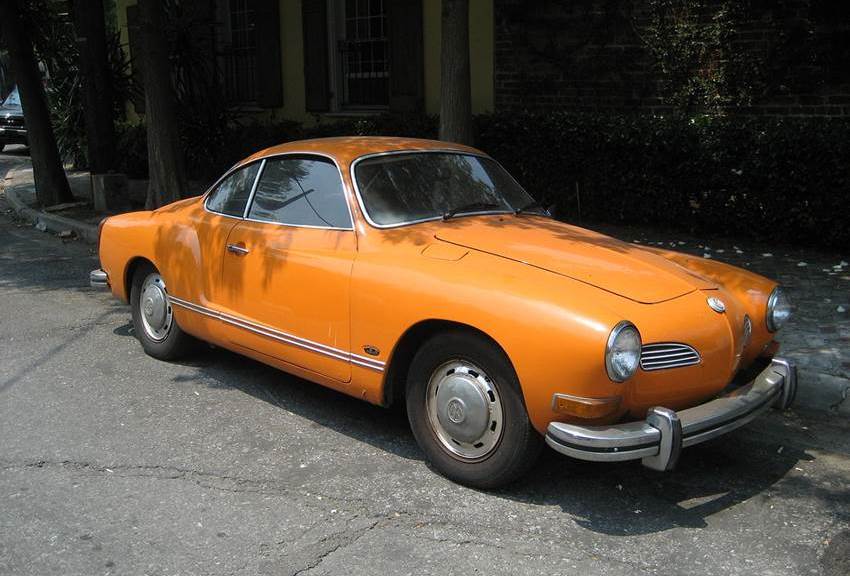
One day I was summoned to the office. One of my dad’s partners, a man named John, asked me to drive his car home. The car was a Karmann Ghia. My heart jumped. This was a <i>sports car!</i> John wanted me to drive his sports car!
This car had an odd history. It had recently been stolen from a car dealer’s lot where John had left it to be serviced. The stolen vehicle was then used as the getaway car in a bank robbery. While the Karmann Ghia looked sexy, it was just a Volkswagen dressed up in a sexy Italian body. With a 40-horsepower motor, this car couldn’t outrun the slowest cop car on the planet. It was tiny, so if the thieves scored several bags of money there would not be room for them in their getaway car. And you sure have to wonder about the intelligence of a bank robber whose plan was to flee the scene of the crime in a bright orange (and badly underpowered) sports car.
That didn’t bother me. I was just thrilled to drive my first sports car!
I was so pumped up that I didn’t want the ride to end. In Wayzata I took a detour and stopped the Karmann Ghia on a little side road that went to the lake. I switched off the engine and sat there grinning with my wheels almost touching the water. Decades later the rock star known as Prince would tease a girlfriend by telling her she had to cleanse herself in the pure waters of Lake Minnetonka. Not me. I just wanted to enjoy the moment.
Then I started my orange car up and went to back out so I could deliver it to John’s home. Only I couldn’t get the Karmann Ghia in reverse. The gear shift offered no hints about how it could be put in reverse. I desperately sawed the shift shaft through the four forward gears, but reverse was just not there! My wheels were almost in the lake. I couldn’t go forward and I couldn’t go backward. I was stuck.
And I was humiliated. If my memory is good, I began bawling with shame as I sat there. The orange Karmann Ghia was just a faux sports car, a 40-horse Volkswagen in wolf’s clothing. I was just a shipping clerk from Iowa, a faux sports car driver who couldn’t even put this car in reverse. Faux car; faux driver. All my fantasies rushed back to mock me.
As some baboons know, it is good to be a reader. I had a tickle of memory that related to the gear shift on Volkswagens. I thrust the shift shaft downward as if to shove it through the floor. It moved down an inch or two, slid left and then snicked into reverse!
I wiped away my tears, backed away from the lake and drove on to John’s home.
Have you ever suffered humiliation when your dreams crashed against reality?







 Trail Baboon