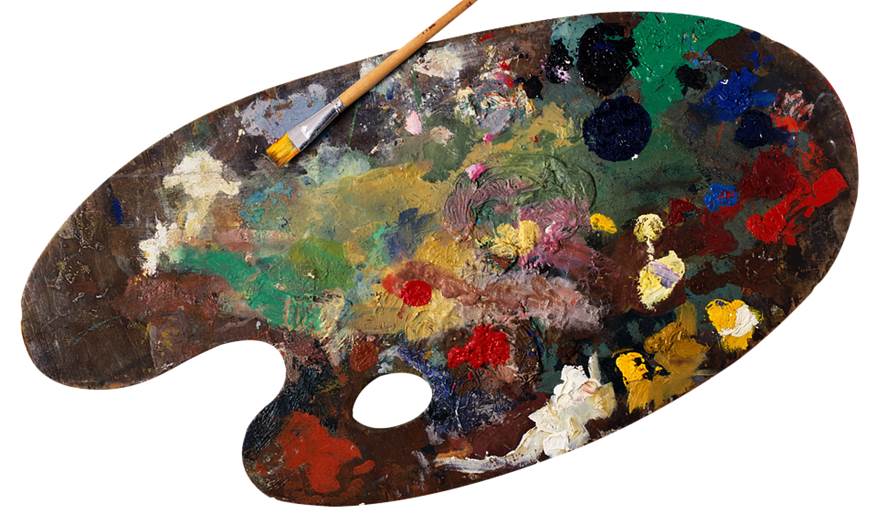
an artists pallet tells you quite a bit about his personality
the color choices and mixes and the way they are mixed on the pallet. the brush strokes on the pallet are as distinctive as they are on the canvas.
you can tell people by their shoes their hairdo their choices re telling . furniture, clothing choices, car, watch, you used to be able to tell a lot about a person by their hat, now its their baseball cap the writing on their shirt the shine or lack of it on their shoes. it is interesting how we all have our own way. i had a friend in the massage and body work business who knew patients by the way they moved. everyone moves differently and distinctly the way you like your eggs, your speech pattern. pick one. which one. how is it the same, how is it distinctive. how is it the same as everyone elses. is it different in minnesota than it is in austrailia or germany or north dakota?
I really like my job. I have never regretted choosing to spend my career as a psychologist in a very rural area. I work at a regional mental health center, one of eight in my state. Every center has psychologists and other mental health professionals. At the present time, there are 12 openings for psychologists at these centers, and it is extremely hard to fill positions. I find this hard to understand, as I can’t think of a better situation in which to practice. One has the support of colleagues, professional autonomy, people who do all the billing, good benefits, and the opportunity to treat just about every mental health condition in the DSM-5. Heck, at many agencies you can even get your student loans repaid through a federal program to entice professionals to under served areas. We have one opening for a psychologist at my agency. I am the only full-time psychologist there.
Due to historical factors too complicated to go into, the supervisor of psychologists at my agency serves two agencies, my agency and the one in Bismarck, necessitating that person drive 200 miles round trip once a week to oversee things out here, and spending one night in our town. Several other administrators do the same thing. My supervisor recently quit to move to another center, so my agency and the one in Bismarck are currently without a supervising psychologist. I applied for the supervisor’s job and interviewed for it last week.
The supervisor’s position is mainly administrative. There are hours worth of administrative meetings at each agency and I would have to go to all of them at both places if I were in the supervisor’s position. I would have to spend one night and two days a week in Bismarck, driving 200 miles round trip, often in poor weather. I would also not be able to see many, if any, clients, and would have no time to do psychological evaluations. The pay isn’t that much higher. Since I am the only full-time psychologist at my agency, there would be virtually no psychology services there. Why on earth did I apply for the supervisor’s position?
I am at the point where I don’t want someone younger and less experienced than I am telling me what to do. I want to be able to exercise some power in decision-making and policy. I interviewed in Bismarck for the position last week. Everyone was kind and congenial, all people I knew and had worked with before. It struck me that I was the oldest person in the room. I was the only applicant for the job. After a weekend of thinking and discussion with Husband, I withdrew my application.
I decided that power and control are pretty illusory, that I can tolerate a supervisor younger than I am, even if they turn out to be a knucklehead, and that I would go bats sitting through endless meetings. I want to see clients and do evaluations. The folks who interviewed me were very understanding. It would be endless headaches for them to make sure that the services I provide now were continued if I had accepted the new position. I noticed an instant reduction in stress and heaviness after I made my decision to stay as I am. Now if we can only convince young professionals that a rural practice can be even more satisfying than city life with its amenities.
What factors are important to you in making your work satisfying, or at least tolerable?
Things get a little frantic at a flower shop in mid-February. If you work in one, it’s wise to keep a sense of humor about it.
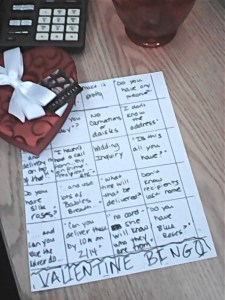
One of my co-workers drew up some Valentine Bingo scorecards to determine who gets all the most predictable and/or oddball questions and requests first.
Among the predictable ones:
“Roses cost how much?” (Yes, wholesale and retail prices go up this time of year.)
“And delivery is on top of that?” (Uh-huh. Wanna come pick them up?)
“Make it pretty…” (Well, we don’t typically try for ugly.)
“What time will that be delivered?” (It’s anybody’s guess. Wish I had a crystal ball.)
And that old favorite, “Are you busy?” (Ha ha ha ha! No! We’re not busy at all! You’re the very first person to ask me that! How very droll!)
And the less common, but still strangely inevitable ones:
“Do you have any peonies?” (Sorry, no. Too early for peonies.)
“Do you have blue roses?” (Only if you want a coat of paint on them.)
“I don’t know her last name…” (But she works at 3M and her first name is Jennifer.)
The wedding inquiry. (Um…your timing leaves something to be desired.)
When you feel as if you’re about to lose all control, you just remind yourself that it’ll all be over soon. And there’s pizza in the break room.
Ours wasn’t the first door she knocked on during a frigid Minnesota evening. Bedraggled, vulnerable but still pretty, 19-yr old Emily showed up on our doorstep, desperately looking for help. How she ended up in Big Lake is a mystery and the last 3 days were a fuzzy high for her. Kicked out of her parent’s house a year before, she was another sad story of a homeless teen with no job, no money, no place to live and an admitted meth amphetamine user. Even her wallet and ID were left somewhere else.
All she had was a phone that had no service or number. She needed a Wi-Fi in order to contact friends via Messenger to find a place to go. My husband happened to be home because he was sick and left work early. I was busy making supper, so Jim answered her knock on the door and brought her into our hearts. I was suspicious, but Jim has a big heart and talked to her to figure out what she needed.
After a several minutes of talking to her, she did not want to see the police or go to the doctor to be checked out. After giving her some snacks, Jim drove her to a nearby Coborns store where they have free public Wi-Fi, and she eventually contacted a trusted friend with a place to stay. I called a youth homeless shelter to find out what else we could do or where she could go. They had an emergency bed available for the night in Brooklyn Park, but we could not make her go.
So Jim drove Emily to her friend’s house in Blaine, listened to her story and showed great kindness with a non-judgmental attitude. I prayed and cried for her and hope for the best for her. Unfortunately, I fear she has a brutal and possibly short life ahead of her until she makes some serious changes.
When have you done a good deed for someone and wondered about the outcome?
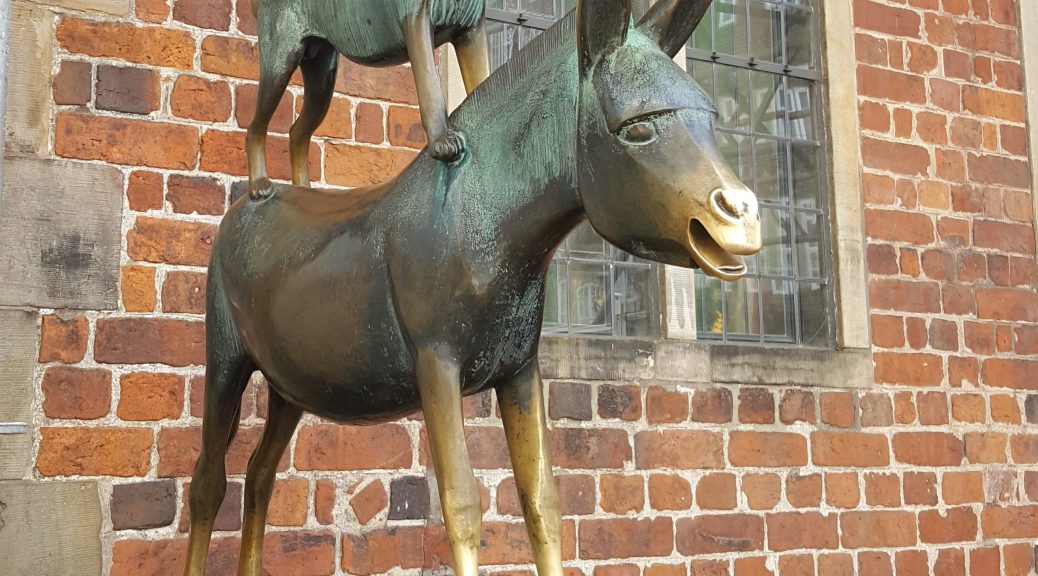
The brothers Grimm wrote many fairy tales set in Niedersachsen, the northern part of Germany where my mother’s family came from. There is a complete travel itinerary from Hannover up to the coast where you can see the settings for many of the stories. It is called The Fairy Tale Road. The stories are not, by and large, comforting, but are, I think, important pieces of literature. I suppose that because my family is so closely associated with Bremen I always was drawn to the story of the Bremen Town Musicians. I remember reading the story in the set of Child Craft books my mother got for me in the mid-1960’s, complete with the picture of the statue in Bremen’s main square. I was really excited to see that statue on our May trip. Both my son and daughter in law were familiar with the story, and they were excited to see the statue, too.
Imagine my dismay when I printed out some travel photos and showed my coworkers the photo of the donkey, dog, cat, and rooster, all making a clamor to scare the thieves away from the farm house, and very few people had ever heard of the story! I could understand why many of our American Indian friends didn’t know the story. They felt so sorry for the animals being neglected and discarded by their owners. Perhaps I am naive, but I thought most Americans my age with any sort of education would know of the Bremen Town Musicians. After all, 46% of North Dakotans claim German heritage. Well, I was wrong.
I rubbed the donkey’s nose after I took the photo in the square, grateful for my parents’ enriching my life with literature. After the dismal recognition rate from my coworkers, I vowed that any grandchildren I may have will know this story.
What stories do you think are essential for children to hear and read?
About 30 years ago I began throwing a holiday party – a silly gift exchange. I’d been to one at a co-worker’s and thought it was a lot of fun. Then 28 years ago I met Alan; he’d been hired as the loss prevention specialist at my company. He had just moved back to the Twin Cities with Julie and their three daughters so I invited them to the party that year. After a lot of gift swapping, Alan got stuck with a red plastic camping egg carton. As I was cleaning up I found it stuck back behind a couch cushion.
This began a 28-year campaign of dumping the egg carton back on each other. It’s been delivered in a box of flowers, left in an Easter basket, sent to an office via a software company in Boston, buried in an ice lantern, left under a mattress, in the dog food barrel, left in the laundry room of a new house. It’s even been to Sweden and Switzerland!
Twenty-eight years ago it was just a prank; I didn’t know at the time that it would also be the beginning of a wonderful, life-changing friendship. Alan and Julie are kind, generous people, sharing their lives with me and Young Adult all these years. We spend our holidays with them and it’s been a joy to see their three girls grow up, get married and start families of their own.
I had a full house at this year’s party and I was pretty sure I would be in possession of the egg carton by the end of the night, even after I frisked Alan and Julie at the door. The last two weeks have been spent poking into cabinets, opening drawers, checking under the sofa, even looking into the dog food barrel again. This morning I took all the ornaments off the tree and as I pulled the lights off, I found a package wrapped in green paper and “decorated” with greenery boughs – the egg carton!
I’ve now sent off the obligatory “You Rat!” text and am busy thinking up how I can dump the carton on them!
I think every parent dreads the day when a child asks “that question.” I sure did. And yet it is almost inevitable that some day your child will come to you to ask the question you have avoided for years. And you can’t avoid it any longer.
“Daddy, I have a big question. You have to tell me: Is Santa real?”
This crisis of faith occurred for me when I was in fourth grade. I was playing with classmates during recess when I overheard a conversation that shook me up. One of my more cynical classmates was explaining that Santa Claus was an elaborate fiction. All that stuff about flying reindeer and delivering presents down the chimney was just a lie.
I didn’t join the conversation, but I began debating the issue in my head. I was that kind of kid.
By coincidence, a few weeks later I joined my dad as he ran an errand at his office at Collegiate Manufacturing, his employer in Ames. His office was in the third floor of the old Masonic Building. Because it was three stories tall, that building was one of the tallest structures in Ames.
While Dad fussed with his paperwork, I wandered over to the window on the north side of the building. Ames had a white Christmas that year, getting a drop of about five inches of snow the day before Christmas Eve. I was already experienced in woods wisdom at that age, having played outdoors for years. Looking out over rows of homes I suddenly knew the truth. Every home below me had an unblemished coat of snow, with no marks of sleigh runners and no reindeer footprints. Santa was a fraud.
All that came back to me when I became a parent and began teaching my daughter about Santa Claus. I bought books for her that showed in detail how Santa did his miraculous work. But when she turned nine I could tell she was beginning to harbor doubts.
Just before Christmas that year, the Pioneer Press Dispatch ran a huge color photo of Santa’s sleigh flying through the night sky. At the head of the team of reindeer was one that had a bright red nose. Molly stared at that photo in silent wonder for several minutes. She finally said, “And I was beginning to think Rudolph wasn’t real.”
Weeks later, right after Christmas, Molly came to me with a serious expression. “Daddy, we need to talk.” A group of friends at school had been debating Santa. Some believed in him. Some did not. Molly volunteered to resolve the matter, saying, “I’ll ask my dad.
He always tells me the truth.” The group agreed to let her research the question by talking to me.
With mixed emotions, I told her. As I remember, I made a big deal of the fact “Santa” was a fiction but Christmas love was not. Rather than debunking Santa I told Molly the love of parents was the true Christmas miracle. She instantly joined the great conspiracy to perpetuate the Santa story with younger children, and it touched me to see how hard Molly worked to preserve the secret with kids who still believed.
All this comes to mind because I just got a note from my daughter. For readers who might not know, Liam is my daughter’s five-year-old son. I’ll let Molly finish this story:
Liam came home yesterday, helped himself to a Christmas cookie and said, “Mom, we need to talk. About Santa.”
Santa and Liam – two real guys
My heart sank. “What about Santa, Hon?”
Liam crammed the rest of the cookie into his mouth, dusted his hands off on his pants and said, “Well, it’s more about his wife.” He leveled a very mature almost-six-year-old look at me and said in a conspiratorial whisper, “She’s not really real, you know. That’s what they say at school.”
After 15 minutes of discussion on the merits of having a wife to look after the elves and reindeer, not to mention to work as an attorney or teacher so that you can essentially run a non-profit for the world’s children, we decided she must really exist after all.
As he left the kitchen in a trail of crumbs and with a red and green sugar cookie mustache, my heart almost broke.
Stay young, little one. Treasure what could be, as well as what is. Believe in magic and your own heart. And dang it–Listen to your mother, not your friends, for just a little longer…
Do you recall how you learned about Santa? Or how you told a child?
My father wasn’t as funny as he thought he was. Don’t get me wrong; he had a lot of wonderful qualities. He was kind, thoughtful, intelligent, generous. But Billy Crystal he wasn’t.
When I was a teenager, he would answer any call that came in after 8 p.m. with “Joe’s Morgue. You stab `em, we slab `em.” He thought this was endlessly funny. My sister and I ended up getting our own phone.
I was thinking of him tonight when I opened a new jar of peanut butter. When I was growing up, if you scooped out the first peanut butter from the center, he’d gasp “Oh, no, you took it from the center!” Of course if the next time you scooped from the right side, he’d throw up his hands in mock-horror and say “Oh no, you took it from the wrong side.” Then when you chose the other side… you guessed it, “Oh no, you didn’t take it from the middle!” Every jar. Everysinglejar.
He’s been gone for 13 years and while I’ve always missed him, it wasn’t until tonight that I realize I even miss his stupid peanut butter joke.
It’s a new-fangled sort of park which sits upon an ancient piece of ground. North Creek Park in Bothel Washington has a boardwalk raised over the swamp. You are there to see a biome closer, perhaps, to The Creation—however you envision that Creation—than the higher ground around the swamp, land which is now the field for suburban one-upsmanship of house, job, child, and toy.
The swamp too is also a competitive field, such as among the ducks into whose spring boudoirs you almost step. Their one-upsmanship is for territory, nesting material, food, and social superiority.
If you are alone when you meet someone who is also alone on the narrow plastic wood pathway, you must make a decision. You can keep silence by pretending to be rapt in the reeds around you and the murky water seeping slowly north under your feet. Or you can talk to the person who passes you by. This stranger and you will intrude in each other’s space for several more seconds than when two strangers pass on the street. Here you walk slowly. You do not come here to be in a hurry. Those in a hurry have other places they must be, which is not to say that those who frequent the swamp are not driven here by a need as well.
I can imagine two people who have met in this way several times until they now expect the other to be on the walkway. Perhaps he is old, wearing bib overalls and heavy shoes, pushing his walker, stopping frequently to sit on the seat of his walker, either from weariness or for new appreciation of a swamp, swamps having been classified for most of his life as wasted ground to be converted to solid land, to serve as yet another field of human one-upsmanship.
Perhaps she is young, stopping often to rid herself of the burdensome effects of her early morning shift at a lunch counter, where she wheedles small tips from people tired from a night shift or still not awake in preparation for a stint of money-earning. After her walk through the swamp she will head to UW-Bothel, where the one-upsmanship of the classroom will prepare her for an adult life of one-upsmanship.
The first time they pass, they ignore each other, or rather she ignores him. The second time she nods at him sitting on his walker. The third time he reads her waitress name tag aloud. “Tish,” he says, “sounds like air coming from an inner tube.” The fourth time he greets her with the sound of air escaping between his tongue and upper teeth. When he does it the fifth time, she realizes it is a tease. Wondering where he gets overalls that round in the middle and short in th legs, she decides to call him Bibs, which tickles his fancy, as does spending even a few seconds with an attractive young woman sixty years his junior.
At the sixth meeting he is sitting on his walker by the one bench along the walkway. She takes the hint for a minute or two. They discuss the nature around them. At the seventh meeting she brings a thermos of coffee for them to share. They discuss where his life has been and where hers is going.
By the twentieth meeting they have explained to each other why they meet, their need for human contact unmotivated by any purpose other than what neither would call love, but which is love indeed.
Sometimes they hold hands lightly, unself-consciously while they talk. Sometimes they say few words. Sometimes one or the other does not appear for their tryst. Neither would ask why. They would now have trust. Their favorite topic would be the nature which has drawn them, not the life that has driven them here. Neither would acknowledge passersby, such as the gimpy old white-bearded man taking pictures which he would perhaps use to paint pastels.
One day it would end. She would graduate and move for a job or for a young man whom she also loves. He might one day not appear; she would not know he had died. Since she knows him only as Bibs, she would not recognize his obituary.
But the swamp would not noticed their comings and goings. The swamp would endure—if human one-upsmanship over Creation can resist the urge to fill it in.