
Today’s post comes from Cynthia in Mahtowa
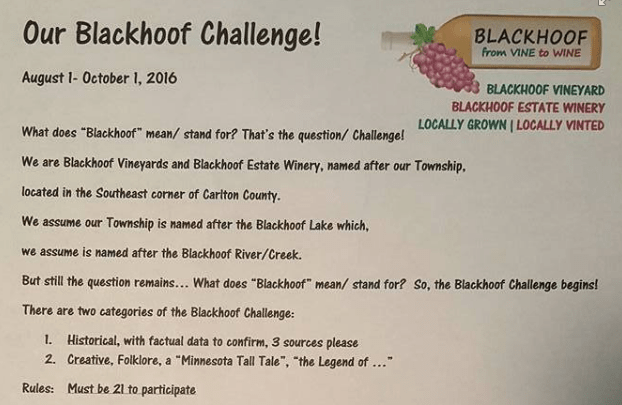
In August I decided to respond to a challenge put out by the Blackhoof Estate Winery in Barnum. (Yes, it’s true, there is a winery in Carlton County at latitude 46.5030° N and barely gardening zone 4. They plan to fill 6,000 bottles of wine this winter. Amazing harvest…but I digress.) They invited people to find the origin of the name Blackhoof which is the name of a river, lake, valley and township just east of my farm.
Researching anything is my favorite indoor sport. MPR finally made use, encouraged and developed my skills for their benefit. But now I am retired, I have to find and/or invent ways to indulge in it.
And so I began.
Warren Upham’s Minnesota Geographic Names: Their Origin and Historic Significance, Volume 17, published by the Minnesota Historical Society in 1920, states that “Black hoof” is the English translation of an Ojibwe word.” Since it doesn’t mention what the Ojibwe word is…I googled and found in an Ojibwa-English dictionary that Makadewaa is “black” and Ninzid (an) is “foot or feet.” Then perhaps Makadenasid might be “black hoof.”
But it doesn’t answer the question “Why” Blackhoof. I traveled to Cloquet to the Carlton County Historical Society for their files on the township and found these:
- Named after a settler of that name (but who was that settler?)
- Named for the abundance of black deer that once ranged the area (I could find no species of “black deer” native to North America though woodland caribou, moose and elk — not any deer– were abundant in the area before the settlers arrived.)
I continued googling…and found “Catahecassa (Black Hoof, possibly from ma‛ka-täwikashä), a principal chief of the Shawnee, who was born about 1740. He was one of the greatest captains of this warlike tribe…He was present at Braddock’s great defeat in 1755, and he bore a prominent part in the desperate battle against the Virginian militia under Gen. Andrew Lewis at Point Pleasant in 1774.”
Cool. But the question then is, what connection is there between the Ojibwe and the Shawnee in Ohio? Well, it turns out that the Ojibwe are part of a large language group of Native American and First Nation people known as the Algonquin “family.” As are the Shawnee.
Then the next question arises, how or why would the Ojibwe in northeast Minnesota know about Chief Black Hoof in the Ohio Territory? Turns out, that some of the Ojibwe on their migration west from the east coast and away from the Iroquois, settled in the Northwest Territory – including along the Ohio River and Lake Erie near the Shawnee.
So, getting closer. After reading what I had learned so far to my 93 year-old Minnesota aunt, she said, ”I’ve heard of Chief Black Hoof.” What? How? She had just read a book called The Other Trail of Tears: The Removal of the Ohio Indians. So I immediately ordered a copy. And then I found the author Mary Stockwell’s website and emailed her. And her reply was, “Yes, there was an Ojibwe-Shawnee connection. . .The tribe often joined the Shawnee in wars against the British (French & Indian War; Pontiac’s War) and then against the United States (American Revolution, Indian Wars of the 1790s, and War of 1812). And they also were among the tribes who ended up in Kansas. (Would you believe I learned that watching a Netflix series, “The Pinkertons?”)
But I still couldn’t confirm that would be the source for the name of the river and lake. And then a friend who grew up in Blackhoof Township, said her father told her it was named after an Indian tribe. Could it be a mistranslation of the Ojibwe word and really should be Black Foot or Black Feet? Down another path altogether? Back to Google. The Black Foot tribe in Montana turns out to also be in the Algonquin language family. And they were once in the Great Lakes area before migrating on to Montana.
And what about the Blackfeet Sioux? I tend to count them out as the Chippewa and Sioux were enemies, not likely the Chippewa would honor their enemies by naming a river and lake after them.
 I found that none of the Ojibwe whom I contacted — Anton and David Treuer, brothers from the Leech Lake Reservation who are both authors and professors; Karen Diver, former Fond du Lac tribal chair currently serving as Special Assistant to the President for Native American Affairs; Linda LeGarde Grover, author and UMD Native Studies professor – have any idea.
So this is where my research stands as of today. I did win the challenge and received a bottle of wine and a cap, along with fame on the Winery’s Facebook page. I also received encouragement — or rather, a mandate — to continue the search.
Do you have any suggestions where to look next?







 Trail Baboon