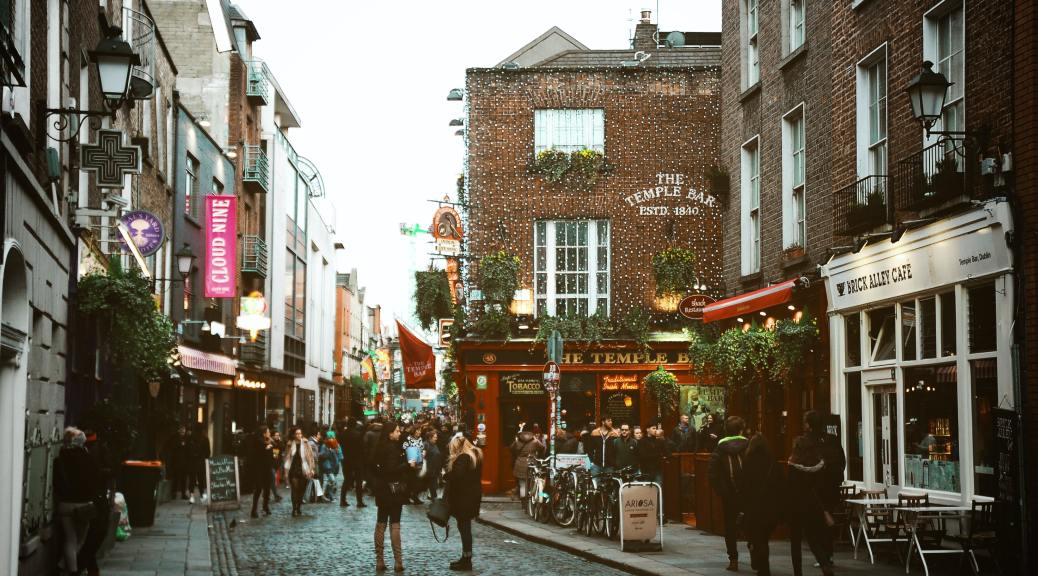
Happy June 16th, Baboons! It is Bloomsday, the day that Ulysses was set. I have to admit I read that book several decades ago and couldn’t make sense of it. I am tempted to reread it now, as I think I have some added maturity to “get” what Joyce was trying to say. We will have to see about that. It may be as incomprehensible as it was the first time I tried to read it in my 20’s. I have really enjoyed hearing recitations of Ulysses on Bloomsday, as it seems to be more accessible when it is read aloud.
What are your experiences with James Joyce’s works? What do you reread?
It’s been cold the last couple of mornings. The sweatpants are back and for those morning walks with Guinevere, I’ve even reverted to adding a sweatshirt to my sweatpants/t-shirt ensemble. And socks – quelle sacrilege! It’s almost like we need a word for this transition season… not quite summer yet, although it should be. Maybe “sprummer”?
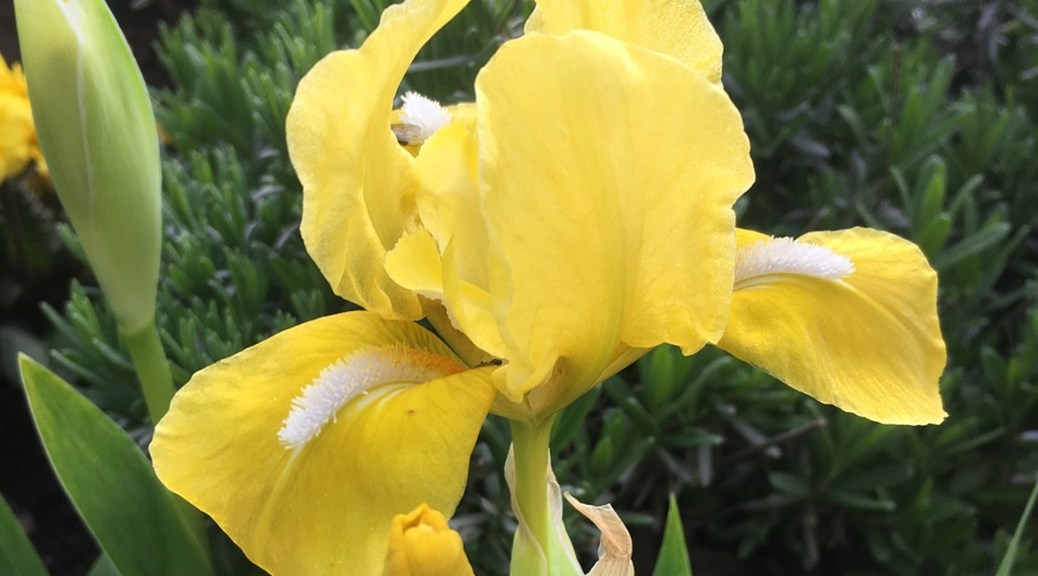
Anyway, even if it’s cold, the walks are glorious because my favorite flower is starting to bloom, not just in my yard but all over the neighborhood – the irises have arrived! I’m not sure why the iris is my favorite. My mom wasn’t an iris fan, but I do remember going to the Missouri Botanical Garden growing up and seeing bed after bed of glorious blooms. In my yard I have pretty much every color, including an orange variety called “orange crush”, although not all the colors have bloomed yet.
This morning looking at a garden full of pale yellow beauties in a yard around the corner, it made me think of a pretty haiku I found a few years ago by a Japanese woman who lived in the 17th century:
Waking from my dream:
what a color
were the iris flowers
Shushiki
Do you have a favorite flower? Or a favorite haiku about a flower?
William and Kate say the kids are out of control. Kurt and Goldie are fighting in public and have called off the wedding. Mutant wasps have arrived in the country via Washington – the same as Covid-19. Hillary has just six months to live. Ted Cruz’s father linked to JFK assassination.
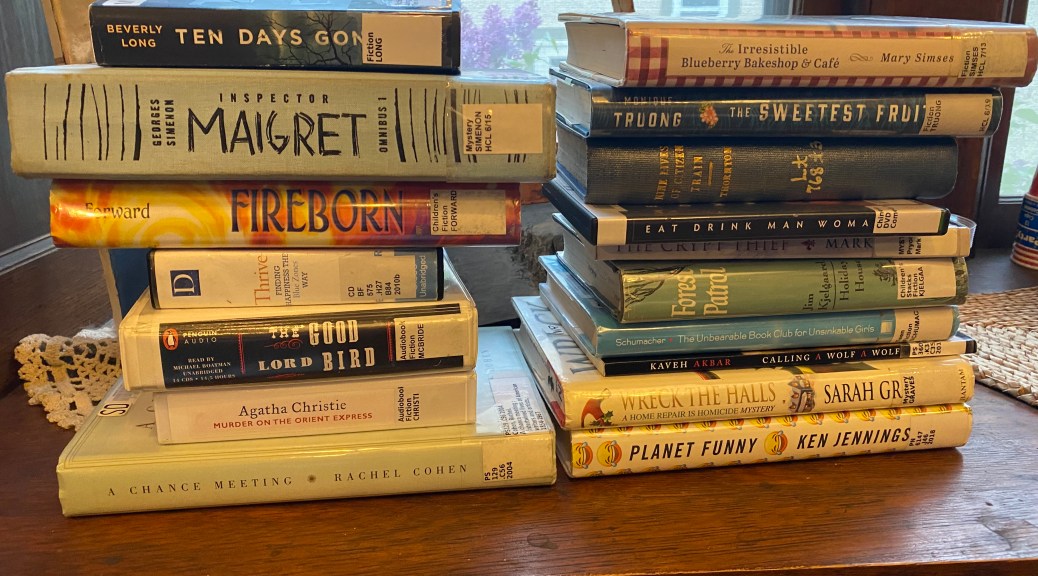
For years I’ve had way more library books checked out than even I can read before they are due; I spend way too much time (at least what most people think is way too much time) curating what I have checked out, what’s on hold, what’s in transit. I’m pretty sure I’ve mentioned that I have my 16-digit library card number memorized. I never thought any of this would ever come in handy – looks like covid-19 is making me re-think this assumption.
By the end of last night, I am caught up. I have read ALL the library books that I had checked out at the time the libraries closed up, plus a couple more that have arrived since my local library started allowing curbside pick-up. I’m not in any danger of running out of things to read… plenty of online stuff and a good number of books that I’ve accumulated over the years but never read. But it’s a nice feeling to be all caught up with the library. I’m pretty sure that as soon as shelter-in-place is over, I’ll be back to my old habits!
Here are a few that I’ve read:
His Majesty’s Dragon (Naomi Novik). 5 stars. Read this (again) for Blevins. Bit of revisionist history of the era of the Napoleanic wars with dragons thrown into the mix. First of the Temeraire series.
The Unbearable Book Club for Unsinkable Girls (Julie Schumacher) 5 stars. This is the same author who wrote Dear Committee Members and The Shakespeare Requirements. It’s a young-adult fiction but a good read and very well written. Four girls thrown together over the summer to discuss their school required reading list.
Natural History of Dragons (Marie Brennan). 5 stars. Bit of very fun fiction from the viewpoint of a female “dragonologist” at a time when women were supposed to be staying home and knitting.
Murder on the Orient Express (Agatha Christie). 5 stars. Read this again (read all of AC in high school) to refresh my memory on which of the two movies was the most loyal to the book. Although I am normally irritated by mystery writers who don’t give you all the clues, since I already know who the murderers are in all her books, I was able to let it go and just enjoy her writing. (And the 1972 movie was much closer to the book!)
The Crypt Thief (Mark Pryor). 4 stars. Found this when I was looking up the video on the French cemetery that was discussed on the Trail in February. Murder mystery involving the Pere Lachaise Cemetery in Paris.
I know you’re worried that I’m going to review every book I’ve read in the last 2 months, but I’ll stop here (except to say no need to read Fooled by Randomness (Taleb) or Wreck the Halls (Graves). Only 2 stars each.
What’s the latest book you’ve finished “in place”?
I thought last month when the water pipe burst in the wall of my best friend’s apartment, soaking much of the the flooring, that she was one of the most unlucky persons I knew. The burst pipe was one in a long string of unfortunate events in her life. Her issues pale in comparison with another friend of mine who, since Easter, was diagnosed with thyroid cancer, had surgery that permanently damaged her vocal cords, and then got the terrible news that her only son, who she had placed for adoption forty years ago and reconnected with last year, had died of the Covid-19 virus. She writes that her life has turned out like a country western song full of bad luck and disaster. She has supportive family and friends, but how on earth do you get beyond these sorts of tragedies?
I don’t know why but I couldn’t help thinking about e e cummings poem, nobody loses all the time after hearing about my friends’ terrible luck.
It isn’t exactly a comforting poem, and I suppose it cold be construed as pretty irreverent, but I think it sums up a need to find hope in the darkest of times.
Husband declared the other day that his private Hell consisted of dealing with paper (he has neuropathy in his fingertips from diabetes and can’t sort or easily manipulate papers or feel his fingers on a keyboard), keeping organized the cords for our various computers, phones, and tech instruments, and the internal combustion engine. He is in Heaven, on the other hand turning a phrase or writing a psychological evaluation.
Turns out yesterday was Tolkien Reading Day. The Tolkien Society organized the first Tolkien Reading Day back in 2003. If you’re a really big fan, you’ll know that March 25 was the day that the Black Tower was destroyed and Sauron, the Dark Lord was defeated.
Tolkien was a fascinating man. Born in the late 19th century, he served in WWI, studied with honors at Oxford and then returned there as a professor. He wrote many books and articles during his years of teaching, publishing The Hobbit when he was 45 and finishing the Lord of the Rings when he was close to his retirement.
I read The Hobbit the summer of 1973 while I was living in Northfield and working at The Ole Piper Inn. All my Carlton friends were scattered for the summer months and my boyfriend was doing an internship in the Twin Cities; except for the weekends, I had a lot of time on my hands. I had never read any fantasy prior to this, in fact didn’t really understand that there WAS fantasy. It was still a subset of science fiction, and I hadn’t read much of that either. After all these years, I don’t remember exactly why I decided to read The Hobbit, but within pages I was hooked. I was not scheduled at the restaurant that night, and I just kept reading and reading. I finished it the next morning, having not slept a wink.
The Hobbit turned out to be the door into the fantasy genre for me. I immediately followed up with the entire Lord of the Rings triology, Piers Anthony, Terry Pratchett, Terry Brooks and on and on. Then I found Ursula LeGuin and Anne McCaffrey who gave me the beginnings of my dragon fixation. To this day, while I probably read more straight-up fiction, the fantasy genre is still my favorite. And if I need “comfort” reading, that’s right where I go.
It says a lot about you when you really decide that there is a crisis going on. Work from home? Concert cancelled? Dog class postponed? Even the decision to stay away from Target for now didn’t bring it home to me until this: Tuesday morning I got a note that the Hennepin County Library is closed until at least April 6. Oh, the inhumanity!
Of course, it’s ridiculous to think this will have a serious impact on my life. First off, I still have 14 books checked out; the library computer generously changed all the due dates to April, even the interlibrary loans. Second off, there are tons of audio books online and I could always break down by reading books on my phone or pc. Then there is the third off; I probably have 50 non-library books in the house that I haven’t read yet either. I don’t think I have to panic. Matbe Funny Planet by Ken Jennings (the Jeopardy guy) will be my next read.
This was one of the poems last week on Writer’s Almanac.
The Cross of Snow
In the long, sleepless watches of the night,
A gentle face—the face of one long dead—
Looks at me from the wall, where round its head
The night-lamp casts a halo of pale light.
Here in this room she died; and soul more white
Never through martyrdom of fire was led
To its repose; nor can in books be read
The legend of a life more benedight.
There is a mountain in the distant West
That, sun-defying, in its deep ravines
Displays a cross of snow upon its side.
Such is the cross I wear upon my breast
These eighteen years, through all the changing scenes
And seasons, changeless since the day she died.
Henry Wadsworth Longfellow
Although I’ve never been a huge Longellow fan, I had been thinking of Rhiannon right before I clicked on the site, so this poem really spoke to me.
Of course, I had to look up “benedight” (it means blessed) and that led me down a rabbit hole where I eventually found this spoken version on YouTube.
The poem is read by Jean Aked, but I found it a little off, partly because it’s a woman’s voice narrating a poem from the point of view of an older man, but also because of her English accent; Longfellow was such a quintessential American poet.
Several years ago I might not have really noticed this, but listening to lots of audiobook has made me a bit of a voice “connoisseur”. There are quite a few book narrators whose voices I recognize when I hear them and I have favorites: Simon Vance, Robert Bathurst, Jayne Entwhistle. I usually like it when authors narrate their own books (like Bill Bryson) because they bring a special nuance to their own material. Occasionally I don’t like a narrator at all, which can actually sour an audio book for me. One of the most prolific audio book narrators is George Guidall. Unfortunately, the very first audio book that I heard him narrate was something I just couldn’t stand. So even after several years, every time I hear his voice it takes me right back to that dreadful book and I have to really concentrate to get past my negative feelings. But he is a very good narrator so I continue to try to get past this.
All this leads me back to the Longfellow poem. I’ve heard two narrators read it now and I think I’ll stick with the Garrison Keillor version!
It’s the story of your life. Who would you like to narrate it?
I thought when I left Winnipeg for the last time in 1988 that I would never live in another place so full of Ukrainians. There are hordes of people of Ukrainian ancestry in Manitoba, and they weave a fascinating influence into the tapestry of region. There are elementary schools in Winnipeg that have Ukrainian language immersion classes. You can get Ukrainian food in lots of places.
Imagine my surprise when we moved to western ND and found ourselves fifteen miles from Belfield, a vibrant Ukrainian enclave of immigrants and their descendants with a strong cultural identity and customs, including a Cultural Institute, Ukrainian churches, and a summer dance festival. There are locally made perogies in all the grocery stores here.
I was talking with a Belfield native last week, a foster mom and Licensed Addiction Counselor, who is married to a Ukrainian national who immigrated about ten years ago. She noticed my diploma from the University of Manitoba, and asked how expensive tuition must have been for me, since I was a foreign student. I told her that tuition was “Cheap like Borscht”, as there was no differential cost to out of Province students. She was amazed about my description of tuition costs, since the only person she ever heard use that phrase was her immigrant husband.
The foster mom found her husband in Winnipeg at a Ukrainian dance competition. “Cheap like Borscht ” is a common phrase in Winnipeg. I assumed it was something everyone said, but apparently not. I think it is a lovely phrase.
What are your favorite turns of phrase? Got any good Borscht recipes?