Category Archives: Science

Jurassic Coincidence

Last summer I read a string of books that I didn’t enjoy – all from my self-imposed “lists”. I beat myself up for a bit and then went to the library website and typed in “dragon”.  All kinds of books came up, from all the Ann McCaffrey books to The Black Dragon River (a book on a journey down the Amur River) and then Dragon’s Teeth by Michael Crichton.  I’d never read anything  by Crichton (not sure how I managed that) so I put it on my waitlist.  This was the book that his wife found among his papers and published posthumously.

I just finished it and really enjoyed it. The postscript shed light on which characters were fictional and which were historic.  Charles Marsh and Edward Cope were real people – famous in paleontology for their 19th century rivalry.

Fast forward 24 hours. I just started A Brief History of Almost Everything by Bill Bryson (about the only Bryson I haven’t read yet – but that’s another blog).  As I got to Chapter Three, suddenly he is talking about Marsh and Cope and their rivalry.

I understand in my head that coincidence is just coincidence, but sometimes in my heart I wonder how I can go six decades and never discover something, then within a day or so, run across it again. And we’ve talked about it here before – including pointing out that it is common enough that there is a phrase for this – Baader Meinhof.  We’ve even put this phrase in our Baboon Glossary.

But it still amazes me when it happens.

Any coincidences in your life lately?

Dieter Substitution

I didn’t have the television switched on too much today but I think I saw Marie Osmond at least three times. It occurs to me that I haven’t seen her hawking her diet system since before Halloween. Interesting that the diet ads start up right away on January 1.

Weight loss is the number one resolution in America these days (and has been for decades). And I read something recently that says most folks have blown through all their resolutions after six weeks.  I’m guessing that means we’ll have plenty of Marie Osmond until Groundhog’s Day.

I also saw recently that PETA wants to replace Puxatawny Phil with an animatronic groundhog. This seems absurd to me; would we really be able to program it to recognize its own shadow and forecast the end of winter? Of course, we could always program it to monitor diet ads; once spring and summer arrives, the ads drop off. This made me wonder if we replaced Marie Osmond with an animatronic dieter, maybe SHE could tell us when winter is ending and save PETA the trouble of replacing Puxatawny Phil!

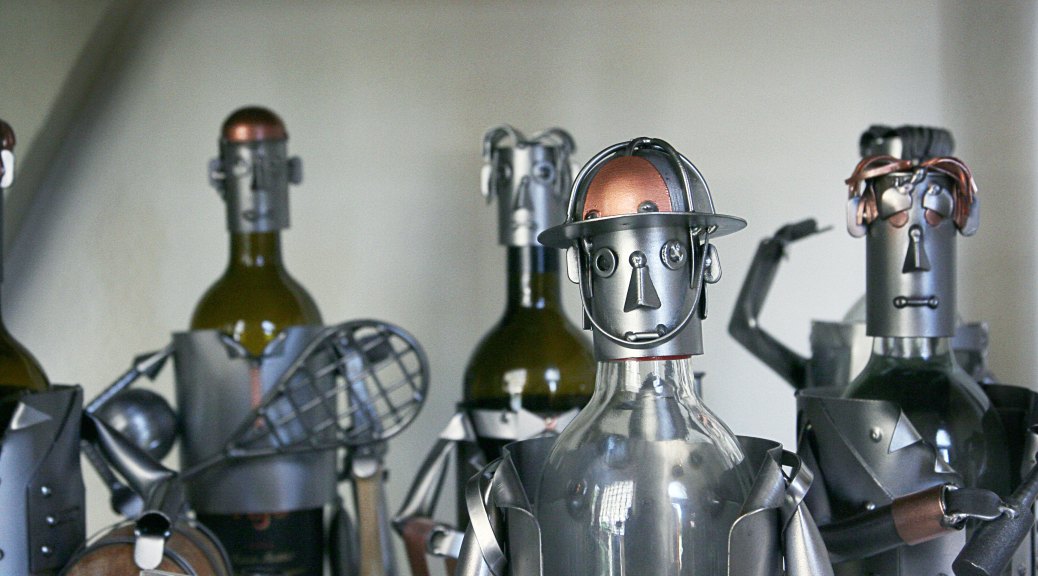
What robot would be useful in your life?


Elusive Darkness

Today’s post comes from Barbara in Rivertown

Just as “sound pollution” makes it difficult in most of our country to find a place where there is complete quiet, “light pollution” means it’s difficult to find a place that is totally dark. You may have seen a map like this of the United States, showing our light-polluted spaces. Some of the ramifications in my life:

– The only time I have really seen the Milky Way was on a trip to Utah in 1995.

– I’ve learned to use an eyeshade in the times of more daylight, allowing me to sleep better. And when I get up in middle lf night, I don’t really need a night-light to find my way to the bathroom.

A dancer friend writes a couple of blog posts a month, and her November 28 post is about what she calls “holy darkness”.    I quote:

– “Darkness is the absence of light but it is not the absence of the Divine.”

– “Years ago friends told me about a lecture exploring how electric lights have completely changed our relationship to night and experience with darkness. Our conversation inspired us to experiment with fasting from electric lights for an entire night. We call it our holy darkness practice. We bring out candles and get very cozy. “

I hope to find a night soon, at this darkest time of year, when I can spend at least a couple of hours with just candle light, and experience what I can of darkness. How long I will last without my lamps, lighted screens, and phones I cannot say. I might read a book by candle light, or find someone to tell stories with. I will be sure to do this AFTER supper… I don’t feel like cooking over a candle flame.

What would you do with an evening of “total” darkness, except for candle light?

Another One Bites the Dust

The news is in. DNA scientists have tested the Yeti “relics” – samples that believers have kept over the centuries.  All turned out to be some  type of bear DNA (and one dog).  So I’m thinking that Yetis are busted.

What’s your favorite mythical creature?


Learning Curve

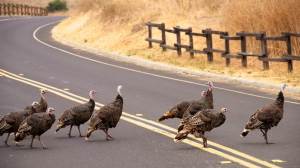
Yesterday I had to stop while a small flock of turkeys took their time crossing the road. Then today it was a fairly large gaggle of geese that slowed me up; I’ll admit I gave my horn a couple of quick toots to hurry them along.

It made me think about the animal crossing system that they have in Canada along Banff National Park. All along the Trans Canada Highway through the park, they built overpasses and underpasses for the animals to use.  According to Parks Canada, they have documented hundreds of thousands of animal crossings and saved thousands of animals from becoming roadkill.

Apparently coyotes, cougars and black bears figured out the crossings the fastest. Grizzly bears and wolves took the longest.  But no one answers my question.  Did they just open them up and wait for the animals to give them a try or did they try to “train” wildlife, perhaps using bait? Maybe it was it just a “build it and they will come” kind of thing?

It occurs to me that I’ve had animals in my life that would learn something like this quickly, like the black bears and I’ve also had animals that would be trailing behind the grizzlies.

Have you had a particularly smart (or not) animal in your life?

Twilight Time

Have you ever been waking up in the morning and hear the phone ring, then become fully awake and realize you just imagined it? If so, you may have experienced an auditory hypnagogic hallucination.

In August of 2015, Dr. Laurence Knott of the UK wrote:  “Hypnagogic or hypnopompic hallucinations are visual, tactile, auditory, or other sensory events, usually brief but occasionally prolonged, that occur at the transition from wakefulness to sleep (hypnagogic) or from sleep to wakefulness (hypnopompic). The phenomenon is thought to have been first described by the Dutch physician Isbrand Van Diemerbroeck in 1664.[1] The person may hear sounds that are not there and see visual hallucinations. These visual and auditory images are very vivid and may be bizarre or disturbing.”

And Wikipedia describe it this way:     “Hypnagogia is the experience of the transitional state from wakefulness to sleep in humans: the hypnagogic state of consciousness, during the onset of sleep. Mental phenomena that occur during this “threshold consciousness” phase include lucid thought, lucid dreaming, hallucinations, and sleep paralysis.” As you can see, there are several other “conditions” mentioned, that I don’t have the time to explore here.

I love what is sometimes called the “twilight time” as I drift off to sleep, and frequently have little vignettes play out before my eyes. Rather than thinking of it as a medical condition to be “treated”, I often wish they would last longer.

Do you experience any sort of hallucinations upon waking or falling asleep?

They All Fall Down

I found this on You Tube yesterday – got to it from one of my favorite science blogs.

This is amazing to me for a couple of reasons. First off, it’s not just the work of laying out all the dominoes.  You don’t just come in one morning and start randomly setting up dominoes.  Something of this complexity needs to be mapped out ahead of time and I means seriously mapped out.  You have to know exactly how much space you need, you need to know how much time it takes for domino trails to fall, you need to know how many of each color, you need to know how to set them up so you know what they’ll look like when they fall down… a pretty long list.

But I think one of the most amazing things is that you don’t really get to test this. It took a team of 19 individuals from around the world a week to get it all set up.  There is no test-run.  You pull the first string and then you hold your breath for the 12 minutes it takes.  You really have to have confidence in your abilities to take part in something like this.  I’m not sure I have enough obsession or emotional strength for it!

What feat of engineering do you admire?


Making Predictions

I was happy to wake up on September 24 and find that the world hadn’t ended as David Meade, biblical numerologist, had predicted. I believe he recalculated after he found things were still the same on the 24th as they were on the 23rd, and predicted another date for our demise  on  October 15th.  The rogue planet Nibiru, violating all physics principles, is predicted to collide with earth and set in motion all sorts of rannygazoo.   We shall have to see what happens. I believe that is the date of  Blevin’s book club.  At least you will all be together.

It isn’t easy to make accurate predictions.  Our world is so random that people search for certainty and cling to the idea that we can make sense of the universe. Consider poor Harold Camping,  the evangelist and radio host who made multiple predictions of the Earth’s end in 2011,  and who finally admitted in 2012 that he was sinful for even trying to make such predictions, falling back on Matthew 24:36 “of that day and hour knoweth no man”.

I am often asked as part of my work to make predictions regarding human behavior.  Psychologists have a myriad of tests and ways of making such predictions, but it is never completely 100% accurate. I know that people who score certain ways on tests of cognition and memory probably have dementia.  I know that people who score in certain ways on tests of emotions and personality probably have certain  mental health diagnoses.  I feel pretty certain predicting that parents with drug and alcohol use disorders  who previously neglected and abused their children will probably do the same thing if they continue to abuse substances.   I can  predict, however, with almost 100%  certainty, that if people are allowed to purchase machine guns, those guns will fired off.  That is probably the easiest thing to predict, and you don’t need an advanced graduate degree to do so.

When have you been able to say “I told you so”?

Cause and Effect

I have been greatly interested recently by pronouncements by certain individuals in the press attributing our recent weather disasters to homosexuality, gay marriage, Mitt Romney, Obama, and/or loose morals in New Orleans.  The capacity of the human mind to find causal relationships between totally unrelated things or concepts is fascinating.

According to Wikipedia  “In statistics, a spurious correlation[1][2] is a mathematical relationship in which two or more events or variables are not causally related to each other, yet it may be wrongly inferred that they are, due to either coincidence or the presence of a certain third, unseen factor (referred to as a “common response variable”, “confounding factor”, or “lurking variable“).”

There is a web site devoted to such correlations (www.tylervigen.com) where you can choose the variables to see how they may be statistically related.  I always knew that there was a strong, positive correlation between the price of Jamaican rum and the average salary of Methodist ministers. Did you know, however, that there is a strong positive correlation between:

The divorce rate in Maine and per capita consumption of margarine

The age of Miss America and number of murders by steam, hot vapours, and hot objects.

Per capita cheese consumption and the number of people who died by being tangled in their bed sheets.

Total revenue generated by arcades and the number of computer science doctorates awarded in the US.

What alarms me is that some people will believe anything and will try to find relationships between things that can’t possibly be related, just to support their beliefs or prejudices.  I, personally, try to remain rational and sceptical. I think I will go now and eat some bread crusts. I am trying to make my hair curly.

Come up with your own spurious correlations.

A Mystery

Today’s post comes from billinmpls.

A couple of weeks ago, I noticed the sign you see in the header photo planted on a street corner near my house. A commonplace, innocuous sign, one I might have not noticed at all except for two things:

1. Except for the picture, which looks a little impersonal- like the sort of photo that comes when you buy a picture frame, there’s no information about the dog. Nothing about the breed or his name or the neighborhood he usually calls home.

2. That curious statement, “Do not approach or chase”. Did that mean that the dog was dangerous in some way to approach?

I would likely have forgotten about the sign except that, recently, I saw the same sign in a completely different part of Minneapolis, three or four miles from where I saw the first sign. Usually when a pet is missing, you see a few signs posted  on telephone poles around the neighborhood. They’re not generally as elaborate as the two signs I had seen and they don’t usually blanket the city.

And then, when I was driving in a fairly distant northern exurb—Blaine or Coon Rapids—and I saw almost the same sign. It had a different dog photo and a different phone number, but the same layout and the same exhortation: DO NOT CHASE!

The thought struck me, “What if the signs are not about lost dogs at all?  What if they are some sort of anonymous signal to someone or some group, hiding in plain sight? After all, nobody who doesn’t recognize the sign as a signal is going to call the number if there is, in fact, no lost dog.

I had decided to keep my eyes peeled for more of these “Do Not Chase” signs and to try to discern some sort of pattern in their placement and then tried searching online to see if anyone else had noticed these curious signs. And that’s when I came across an article in a minor paper that purports to explain the mystery. It turns out that there is an organization of volunteers who make it their mission to help people recover lost pets. They call themselves “The Retrievers” and they have established a protocol for how they proceed. One thing they do is to put up signs over a very wide area. Lost dogs sometimes travel surprisingly far from their home, apparently. Another distinctive feature of their protocol is that they always urge informants not to chase the dog if they spot it. Lost dogs are stressed as a rule and in survival mode. Chasing them exacerbates that and can make them harder to find and coax into confinement.

My mystery turned out not to be especially mysterious after all. That is, unless the article in the little local paper was just a red herring to throw us off the trail. But there are other unsolved mysteries around us, mysteries that beg an explanation. Like that business that never seems to have any customers and yet has been there for years. Is it a front for something? What about that house where you’ve never seen anyone come or go? That guy you’re always seeing. Doesn’t he have to be somewhere? What’s he up to?

I was walking the dog one morning and passed by an unremarkable house. A pickup truck was in the driveway of the garage and the hood was open. One of the truck’s doors was open and the radio was on and playing an Ernest Tubb song. The back door of the house opened and an older man came out and walked toward the truck. He had on a seed cap of some sort, baggy jeans, a heavy plaid wool shirt. And red high heels. I thought to myself, “I’ll bet there’s a story there…”

Noticed anything unusual lately?