Category Archives: Travel

Ship Ahoy!

Today’s post comes from  Steve Grooms

When I was a boy the most romantic and impressive form of transportation was the train. I grew up listening to the lonely nighttime screams of passing trains. A kid in my school was so involved with trains that he memorized data on all the train travel in Iowa. You could ask him any kind of question about trains. He’d barely pause before reciting details of train schedules.

I’ve never had that kind of mind. I’m a “big picture” guy, not a detail guy, someone more attuned to forests than to individual trees.

The closest I ever came to developing an esoteric interest was when I fell in love with a hand-carved carousel built a century ago. I was smitten to the point of reading a lot of background knowledge about carousels. It is a topic I can talk about at length. But in the end, I could not work up enough interest to become an expert about all the various makers of carousels in the country. A true lover of carousels would be fascinated by obscure little carousels that just look garish and cheap to me. My deepest affections were for one splendid carousel, not the whole category.

This comes to mind because my daughter is in the early stage of becoming immersed in a new interest for our family: ship watching. My son-in-law grew up in a lovely old home on the US bank of the St. Clair River. The St. Clair is deep enough to host the biggest ships sailing the Great Lakes. The river is, in fact, the only connection between the upper lakes (Superior and Michigan) and lower lakes. Any ship traveling far in the Great Lakes must pass close to John’s home, “close” meaning about a hundred yards. Now that our family lives in Port Huron, Molly has become fascinated with the ships we see here.

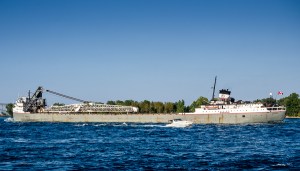
The photo heading this column is one I took in late September. The ship is the Federal Seto, a particularly lengthy “saltie.” It is owned by a shipping company based in Montreal. Since I took its portrait the Federal Seto steamed through Lake St. Clair, passed through Lake Erie, and then through Lake Ontario. After running the length of the St. Lawrence Seaway, today the ship has just entered the Atlantic Ocean on its way Rouen, France.

The major distinction between different bulk freighters on the Great Lakes is between “salties” and “lakers.” Salties are shorter than lakers and have higher sides. They move freely from lake to lake but also across oceans. Lakers, many of which are about a thousand feet long, cannot fit in the locks that connect the Atlantic Ocean with the Great Lakes. They work hard but always within the Great Lakes. In addition to being shorter and taller than lakers, salties are younger. The salty water of oceans is extremely corrosive, so salties rarely live longer than 20 years. By contrast, because lakers are not subjected to all that salt they can live many decades, even longer than a century.

Ship watching is popular hobby in this area, and there are many resources. Web sites track the movements of these ships. Many museums educate visitors about the shipping trade. There are books on ship watching, and newsletters. If you want to know the precise location and sailing plans for individual ships, “there is an app” for that. There are, in fact, several apps for smart phones that track these majestic ships at all times.

I was surprised by my daughter’s surge of interest in shipping. She has always had an active mind, but this is the first time she has immersed herself in a topic like this. Molly knows a great deal about Great Lakes ship traffic. She has favorite boats that she tracks with interest. She is highly excited by the fact a new ship being built in Europe will soon join the fleets of freighters already working the Great Lakes, and she will be sure to be on the porch of her mother-in-law’s home the first time it travels the St. Clair River.

Have you ever developed a fascination with an esoteric topic?

Packing

We are traveling by van for the next 10 days. We are going to a play therapy conference in Minneapolis.  As we can’t bear to let produce spoil, we are taking along our canning equipment, jars, rings, lids, and boxes of ripening tomatoes.  We must be out of our minds.

How do you pack for a trip?


In Search of My Irish

Today’s post comes to us from Jacque.

By the time you read this, I will be in Ireland. I could not get my head around how to tell one of these stories. It is cruel and overwhelming and unbelievable. It stopped me cold when I started to write it.

The group I am travelling with is a group of polymer clay artists who have been the students of our teacher from Jordan, MN, Maureen Carlson. She has for years had a teaching studio where people came to learn from all over the world.  One of those students is an Irish priest Father John.  Maureen closed her studio nearly 2 years ago to semi-retire.  He cut a deal with Maureen—let me come over for lessons one more time, and then the next year you can bring a group to the retreat center I run in Ireland for another 5 day lesson.  She said SOLD!  I was invited to attend.  I said yes.

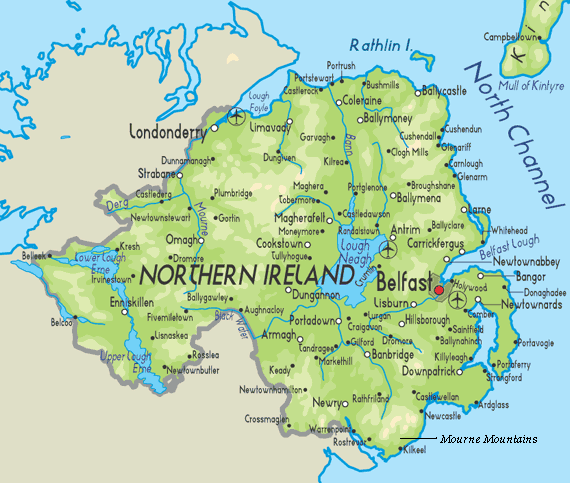
Weirdly, this retreat center is located in the Irish county where my ancestors emigrated from in 1841 to Canada, County Down. That is my mother’s side.  You can the read the story of my great grandfather at this link:

https://www.bookemon.com/book_read_flip.php?book_id=278253

That story is stereotypical. The Newells wanted a better life.  They emigrated to Canada, then Iowa to homestead and did very well.  I hope to travel to see the old stone house the Newells lived in on the sea.  It is still there, 25 miles from the retreat center

The story I found in Ancestry.com on my father’s side knocked my socks off. I had no idea.  This is located in the county north of Down, in Antrim where Belfast is located.  I understand the Irish hatred of British after this one.  Sorry this is so long.  Here we go:

“The year was 1548 and it was in Ireland and it was time to pay Taxes to England . Ever year England would send a small army of tax collectors to Ireland to collect taxes, The people of Ireland had very little money and never enough to pay taxes to England . The tax collectors had been given the right from their King Edward V to take any thing of value to pay the taxes owed. It was the practice of King Edward and Mary Tudor to take Children in payment of the taxes. The children were taken to England to be trained as domestic servants and bonded labors.

This small village called Antrim, in the Ulster Province and of the MacDonald Clan was no different than any other village in Ireland everyone had to pay taxes one way or another, And this is where my story begins, Young children ages 12 years and older that looked in good health were taken from the family clans as payment for the taxes.From the time that the tax collectors picked the first children until they had over 100 children to go back to England it would take lest a week to 10 days. The children would be put into carts and wagons and most of the time their hands were tied to the racks on the carts to keep them from running away.

One young boy that came from Antrim was called James Antrim. His last name was from where he came from. He was being trained as a cord winder and rope maker. James Antrim was a hard worker and he learned well he also learned to read and write that would help him to get ahead in life. He lived and took his training at the family mansion of Sir Thomas Wyatt . During the five years of training young James Antrim had a hard time at first until his hands and arms got stronger, then he was as good a rope maker as there was.

It was on a spring day on a weekend that James went to the market with three men that he came to see for the first time a young lass with red hair , James had to know more about this young women. James found out that she was a cook’s helper at this master’s house and that her name was Colleen O’Shay . This was the first time that he seen his wife to be. The servant’s Masters was willing to let their servants have relationship with other household master’s  servants.  With the hopes that it would lead to a marriage. This way the servants children would be under the master ‘s care and they would become servants also and it would be cheaper than going to Ireland and bringing back young children to train .

Our ancestors were two of these servants that were married and two of their children came to Salem , Massachusetts, America in 1635. they were Thomas Antram and his wife Jane Batter, . And Thomas sent two of his sons John and James back to England in 1679 to bring friends and to raise funds to buy land in New Jersey. Our Ancestors were early America Pioneers.”

I hope that in our 5 days of touring we get to the Antrim area, as well. I want to know more about this practice of taking children for taxes.  It is guaranteed to create hard feelings that last for hundreds of years. It makes me think about how much I hate taxes sometimes.  Several times, while I owned my practice, I had to reach down deep to pay my taxes, but never did I have to make this kind of sacrifice—a 12 year old child.  I cannot come up with a question for discussion for this one.

What would you suggest as a question?

State Fair 2017

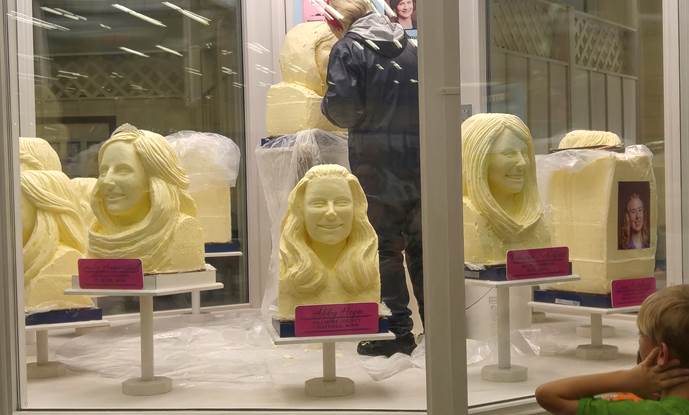
As you all know, I adore the Minnesota State Fair. This year I was able to attend three times: opening day on my own and twice with Young Adult.  Some new things this year: a thorough exploration of the West End area, Macaroni & Cheese Curds, llamas and alpacas in the very back of the horse barn.  And the traditionals as well: Hawaiian Shave ice, bunny whispering, butter heads.  After three years of lusting after them, YA and I caved this year and purchased a big set of Thin Bins, collapsible containers with color-coded lids. We also went home with some t-shirts, assorted bags and cookies.

Even though it is essentially the same parade day after day, it is one of my favorite parts of the fair. I love seeing the different marching bands, the dairy princesses and the art cars.

On reflection though, one of my favorite things about the Fair is the people watching – and the unbelievable “variety” there is in the folks of Minnesota (and Iowa/Wisconsin/Dakota visitors). Lots of different family types, from extended families in matching shirts to young families with their jam-packed strollers.  An amazing array of clothing and shoes – why would you wear bright white tennies to the fair?  Or high-heeled shoes?  Lots of shoppers (YA and I included) getting fancy scissors, wine pouches, shark teeth – this list could go on and on.

So now the fair is finished for another year and I’m already looking forward to next year. If my feet and my pocket book can handle it, maybe I’ll go four times!

Where is your favorite people-watching locale?

What I Did On My Summer Vacation

For the first time in several years I took a vacation that lasted more than three days. I renewed my passport and flew to a country I had never been to before, in a part of the world I had never been to either: Leon, Nicaragua. While still technically in the Northern Hemisphere, it sure felt far South to this Minnesota girl. It was hot. Humid and hot. And wonderful. Would I go back again if given a chance? You bet. I missed the entire Atlantic side of the country. And Leon, the city and state where I spent the bulk of my time, is worth a second trip. There are places I want to revisit and explore more of, history to be absorbed (more on that in another post), and more tasty little mamon chinos that need to be eaten.

There is one part of the trip I do not need to repeat. It was great to have done it once, but once was enough: climbing the volcano.

Nicaragua is divided by a mountain range, which includes a string of active volcanoes. One of the volcanoes has its natural steam harnessed for energy. And one you can climb. If you’re foolish enough. And you have a guide. We had a guide. And I didn’t look at how I had to get down once I was up. So up I went.

Did I mention the guide moved like a bi-pedal Nicaraguan mountain goat?

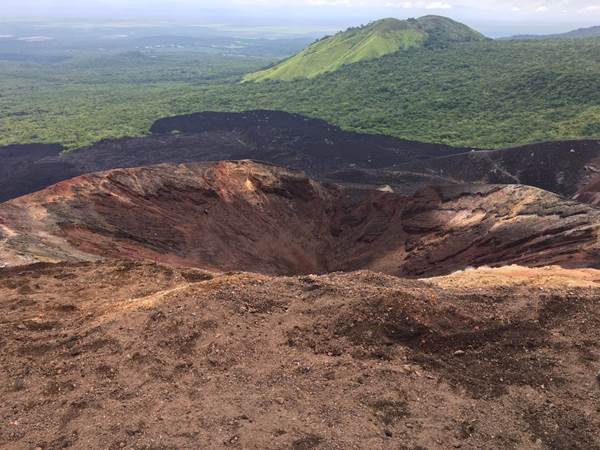
Cerra Negro (“black hill”) erupted last in the 1990s. It spewed ash and pumice for miles – a bit like Mount St. Helens in Washington. Driving through the countryside to get to the park it was easy to think that the farmland was covered in rich, black dirt – until you realized that wasn’t dirt, that was pumice left behind by Cerra Negro. No humans died when it erupted, but plants and farm animals did. Hundreds of people had to evacuate because the surrounding area wasn’t livable. The fauna is coming back, but Cerra Negro itself remains a big black hill with virtually no trees or vegetation of any sort. The locals advise that you start climbing early – that lack of vegetation means you are clambering up a pile of black rocks in full sun. As you get closer to the top you start to get a nice breeze, but that becomes a steady wind that can blow your hat off (and threaten smaller people with toppling over). Did I mention there isn’t a true path? You just have to keep following the route of your native mountain goat guide over the rocks…Good thing he was willing to take breaks on the way up.

As you climb, and once you are at the top, the views are spectacular. It’s lush green in most every direction. The crater of the volcano has its own rust-colored beauty, but it’s not as photogenic as the next hill over. It’s good to stand at the top and recognize you just climbed a volcano. It makes a person feel accomplished. If you are my daughter, this makes you want to do cartwheels and handstands. If you are me, you fret that your child will go tumbling down the steep side of the volcano as she does handstands and cartwheels.

Then you need to go back down. Down is a different route. Down is down through pebble-y pumice that is a bit like deep sand (except it’s far more likely to scrape you). Down is steep, steep like a ski jump that you don’t see part of until you’re on it. Down means leaning back because if you stay upright or lean forward you will fall headfirst down 2400 feet of pumice covered volcano. The guide advised leaning back and going down at a trot. That worked well for Daughter who has no fear of heights (and actually enjoys them). I was less speedy, less graceful, and far more willing after a near panic attack to forgo dignity – scooting and crab-walking down, allowing all fours and my backside to hug the mountainside.

A fair amount of Cerra Negro arrived at the bottom with me in my pockets and shoes (I found yet more in those shoes weeks later back in Minnesota while walking around at the state fair). Up took just over an hour and a half, down took Darling Daughter about 10 minutes and me, um, more than 10 minutes. But I went up, and now I was down, And I can say I climbed a volcano on my summer vacation.

When have you done something even though you were scared?

Its Own Magazine

Turns out the Mississippi River has its own magazine. I have finally finished reading my latest issue of Big River, which covers news of the Mississippi River from Minneapolis, MN, down to Muscatine, Iowa. Its byline is “Covering the heart of the Driftless Area for 24 years,” although there is usually some news about the Twin Cities. (The Driftless area includes Hastings and Red Wing, as well as La Crosse and Prairie du Chien in Wisconsin, Dubuque and the Quad Cities in Iowa, Galena in Illinois.) It is published six times a year here in Winona.

I devour this magazine. First I read all the Big River News segments, which give updates on everything from the Gulf of Mexico’s Dead Zone to a new plastic pollution problem:  tiny plastic particles from people’s microfiber jackets. Besides environmental issues, these paragraphs cover items like a new bike rental system in Clinton, IA, and an expansion of the National Eagle Center in Wabasha. My favorite tells of a new happy hour in St. Paul – the Kellogg Park Craft Beer Overlook: 3 to 6 p.m., Tuesdays through Fridays till mid-October. This September-October issue also has a special sidebar detailing and picturing which ditch weeds to NOT PICK because some part of them is poisonous (poison hemlock, giant hogweed, wild parsnip, and cow parsnip).

Feature articles range from “A Tale of Two Neighborhoods”, about North Mpls. and Northeast Mpls, to a short two-pager on kestrels. For the exploring traveler, an article details sights and places between La Crosse, WI to Winona, MN. Restaurant and book reviews are regular features, as are lots of glossy ads – I don’t mind because they are for things and places that interest me.

I just checked, and Big River is available at Minneapolis’ Central Library, but only for “in-house” use. I’ll bring some back copies next time I get to BBC (Blevins Book Club – see top left of this “page”, under Blogroll).

What river, anywhere in the world, would you like to explore?

Road Trip

Earlier this week I was supposed to meet three of my fellow State-employed psychologists in Bismarck and drive with them to Jamestown to attend five hours of mandatory training related  to treatment planning at the State Hospital.  Jamestown is about 100 miles east of Bismarck. I know all three of my colleagues pretty well and find them to be very pleasant folk, but I was dreading the trip. It would mean 100 miles to Bismarck, 100 miles to Jamestown, and the 200 mile return trip at the end of the day.

We were to travel in a State car,  which usually turns out to be a cramped and uncomfortable vehicle with limited radio options. Moreover, I would be a passenger, not the driver, and that violates my need for control and speed. (It is not a good idea to speed while driving a State car. One of my colleagues did, going about  90 mph, and  she zipped right past the Governor on  the interstate. The  Governor promptly recorded the license plate number,  and had her tracked down and reprimanded.)

Road trips are a fact of life out here since our towns are so far apart. The scenery between Bismark and Jamestown is notable for nice views of migratory waterfowl in “prairie potholes”,  but not much else.  I suppose that the scenery on road trips isn’t as important as the quality of the conversation in the vehicle. I like my fellow psychologists, but I would rather do a road trip with a more diverse and irreverent  group–our church bell choir, for example, or a group of Baboons. My bell choir is very irreverent, like most church musicians I know.

I drove the 100 miles  to Bismarck early in the morning so I could meet up with my colleagues and we could proceed to Jamestown by 8:00 am.  I was dismayed to learn that the training had been cancelled several days earlier, and no one thought to  tell me. I said more than a few cuss words, threw my purse in a temper fit in the parking lot, and drove 100 miles back home, angered and somewhat relieved.  The training has yet to be rescheduled.

Tell about wonderful, horrible, and/ or eventful road trips from your past (or one you are planning) .

Verily’s Geek Adventure

There hasn’t been a total solar eclipse anywhere near my location since before my birth and the geek inside me was thrilled to realize that I would be driving distance from the epicenter of the eclipse path this week. I started making my plans about 3 months back when I was arranging my summer schedule.  Although folks knew I was going, I resisted any “hints” that maybe I needed a travel companion.  I also resisted a concerned neighbor who thought I would be safer if his adult son (who was also traveling to see the eclipse) went along with me.

I headed out on Sunday morning with directions, a cooler full of food and drink, several books, two GPS systems and two eclipse apps on my phone. I35W was its normally fun summer mess of road work with no work happening, but I eventually made it to Osceola where I roomed for the night.  Relaxation, reading and an early bedtime were the only things on my agenda.

My alarm went off at 4 a.m. – not knowing what traffic into St. Joseph would be like, I didn’t want to take any chances. Was on the road by 4:15 and made it to the East Hills Mall at about 6:30 a.m.  I chose that location as it was right in the middle of the epicenter as well as being on the edge of the city (hoped that would help with traffic after the eclipse).  There were people already parked in the lot, but not too many.  As the morning wore on, more and more people showed up and vendors got their tents all set up.  There was music inside the mall and most of the stores were having eclipse discounts. Parked near me there was a family from Sioux Falls who had painted their van, a guy from Jordan with a SERIOUS camera, a young couple from Texas who played cards while waiting, a woman who had flown in from California the day before and an older gentleman from Iowa wearing his safari hat.

It rained twice before the first stage of the eclipse happened and both times everybody scrambled to get their camp chairs and equipment back into their cars. In between the showers the sun came out, making the humidity jump.  When C1 began (when the moon begins its trip in front of the sun), the clouds were still breaking up a bit so we could see the progress.  It looked like a big cookie with a bite taken out of it.  Due to the clouds (and me just using the camera on my phone), I never got a good photo.

Then about 25 minutes before totality, the clouds closed up and it started to rain again. Just like folks who can’t wait until the end of the 9th inning, folks started to pack up their stuff and head out.  By the time of totality, it had stopped raining, but was still cloudy, so while we didn’t see the total eclipse, it did get very dark and cool.  Then, like a little miracle, about 2 minutes after totality, the clouds broke up for a minute and those of use remaining got to see the sun covered 90% – just a little bitty sliver of light.

I had said several times that I would be skedaddling back home after the eclipse but the non-construction zones on 35W with the extra traffic made the 6 hour drive into a brutal 10½ hour drive. I tried to get either of my GPS systems to re-route me, but nothing worked out.

Even though the driving wasn’t great and the weather wasn’t great – I had a great time! I’m glad I got to see what I got to see and if I’m still around in 2024, I’ll try to get to Indiana or the boot heel of Missouri.

What makes it an adventure for you?

One-Way Market

On my trip to Madison last weekend, I went to the Dane County Farmers’ Market on Saturday morning. It is a four-block affair that rims the capital building.  You can enter the market from any of the incoming streets but my friends explained early on that you can only go one way at the market.

As we were there pretty early (6:30 a.m.) and it wasn’t very crowded I didn’t understand the rule about one-way. And it’s not a posted rule either, so that made me want to turn and go the other way very badly.

But after about an hour of very leisurely looking, tasting and shopping, it had gotten very crowded; that’s when I realized the intelligence of the one-way rule. At that point it would have been very awkward (and inefficient) to try to go against the crowd.  My friends told me that in another hour, it would be even worse!

It was a great market – all local folks, no re-sellers. I ended up with a purple cauliflower, a chili-cheese bread, a little tiny apple pie, cherry tomatoes that taste out of this world, squeaky cheese curds, another cheese w/ Kalamata olives and some multi-colored potatoes.  A real score!

When have you gone against the grain?

The Trouble with Ratchets

Today’s post comes from Chris, Reneeinnd’s husband.

Due to an anomaly at birth, I am partially ambidextrous.  I learn to do simple tasks with my left hand and complex tasks with my right.  I allow other people to demonstrate their mechanical prowess while I stand aside to lend assistance.  Attempts to tackle jobs with moving parts commonly end in frustration, absurdity, or disaster.

In July, Renee and  I traveled to see our son and his wife in Brookings, South Dakota so Renee could do a therapy presentation and we could help the kids move into a new apartment.  The new place was quite a step up: it had three bedrooms on two levels, with two and a half bathrooms!  Son and his wife had bought new furniture and had it delivered to the new apartment.  They had to leave several pieces of furniture, including a huge, dilapidated sectional sofa, in the old apartment so it could be removed and hauled to the landfill with my pickup.

We arrived on Friday evening, delighted to see the new apartment. Renee and Son would be at the presentation the next day.  After a pleasant meal, the four of us went to the Lowe’s to get what would be needed for the big move– a big tarp and a set of ratchets with straps.

Son and I went over to the old place and proceeded to load the bulky pieces of the sofa into my pickup and cover them with the tarp.  The next step was to secure the load with the straps and ratchets.

Son and I usually work well together, but he has dexterity problems of his own.  Secretly, I didn’t have a clue–I’d let him take the lead.  Neither of us knew how to spool the straps through the ratchet.  Son used the expedient of the young–he looked up the procedure on YouTube.  By this time, it was getting dark and he  had to use his phone as a flashlight.  He figured out what to do, and we threw the hooked end of the strap over the top of the load.  At that point we inadvertently violated the cardinal rule of ratcheting–always keep the strap straight!  If you don’t, the strap will  twist and get stuck in the spool while you’re tightening it with the ratchet.

Of course the strap got tangled, and the strength of two big men was not enough to unwind it.  Fortuitously, Son’s upstairs neighbor, a veteran  of multiple collegiate moves, arrived.  He was able to pull out the strap so it could be spooled back in to the ratchet.  We tried again, secured the load, and drove the truck to the new apartment, tired but satisfied with a job well done.

On Saturday, Daughter in Law  and I got to do the fun part–driving the pickup to the landfill so we could dispose of the sofa.  We gleefully flung the cruddy pieces onto a smelly pile of rubbish.  We were very careful to wind the straps back into ratchets without twisting them.  I had not repeated the same mistake and was proud of my newfound competence.  I could now use a ratchet on my own–without help!

We showed Son the neatly spooled ratchets when he got home, only to find that the straps were horribly stuck! You’re not supposed to rewind the strap through the back of the ratchet!  Son pulled with all  his might and was able to get one of the spools unstuck.  He had to resort to cutting the other one.  A mysterious third strap was involved.  Although  Son remained calm and patient, he was  clearly disgusted by the situation.  He advised me to ask one of “my mechanically inclined” friends for assistance in the future.

The straps and ratchets are stored in a compartment of my truck.  I am too embarrassed to show my incompetence by asking a casual friend or neighbor for help.  I vowed never to use an  unspooled ratchet and strap again– if I can avoid it.

Have you ever had a guilty secret?  What did you do to conceal your shame?