Category Archives: Travel

The Odd Couple

Today’s post comes to us from Jacque.

Sometime this last summer I saw the strangest thing—a male peacock crossed the road in front of my car in hot pursuit of a turkey hen.   They disappeared into the woods at top speed.

“HMMM, I thought. Did I really see that?”

When I got home I told Lou about it and we had a good laugh, labeling the pair “The Odd Couple.” They were kind of the Julia Roberts and Lyle Lovett of the bird world.  Remember that one?  Two mismatched, high profile celebrities that impulsively got married then inevitably they divorced.

In September before I left for Ireland, I saw a blurb about a similar thing somewhere else on the news or on the internet. I searched YouTube, that faithful documenter of daily life, for similar henomena and came up with an impressive visual library of involvement between peacocks and other fowl.  It turns out that peacocks “sleep” with anybody.  Apparently, peacocks and peahens are the sluts of the fowl world.  I suppose if you have all that impressive featherage, it cannot be wasted.

Here is a YouTube of a news report of a peacock in Victoria, Canada and a domestic turkey .

What sight causes you to say, “Did I see that?”

Free Time

Husband loaded his pickup on Monday of this week and headed to Denver to see his dad and stepmom. His dad is in an assisted living facility due to Alzheimer’s Disease, and he hasn’t seen him for a year. Husband returns home  later today.

I am accustomed to Husband spending time away from home during the week when he works on the Reservation.  He is usually home on Friday, and it was strange not having him here yesterday.  Strange, yet somewhat restful,  since yesterday was the first Friday for eons that it was the end of the week, I was at home, and we were not planning what to cook for the weekend.

Husband is a compulsive cook, grocery list maker, and menu planner. I can tell when he is thinking about cooking something.  He has this broody look on his face and gets real quiet. If I ask him what is going on he says “Just a minute”, and, many, many minutes later, he tells me what foods  he wants to prepare.  This only happens when we are at home. He recognizes how odd this is and confesses that he can’t stop thinking about cooking when he is at home.

I got off work early yesterday. I was content to eat ham sandwiches and breakfast cereal. The free time was nice, and I had had a restful afternoon playing with the cats.

What do you like to do in your free time?  What do you find relaxing?

Iguana Joe’s!

Found Iguana Joe’s on our first full night in Aruba. Close to the hotel and a few vegetarian options.  After dinner YA chose a dish with Oreos in it for dessert; she thought it would be a pie with Oreos in the crust.  Turned out to be deep-fried Oreos!

What dessert would be a pleasant surprise for you?

Airplane Adventures

Many years ago a client and I had a challenge to each read Hawaii by James Michener before a trip to Maui.  The description of the ship voyage from Boston around the tip of South America to Maui and the space that passengers were allotted made me vow to never complain about air travel.  So the following is not complaining, just a detailing of our adventure.

We left the house at 5:15 a.m. so that we would be at the airport 3 hours ahead. All the industry talk for the last couple of months has been about how long the security lines at MSP have been due to re-vamping of the system.  Well, I’m here to tell you that they are now re-vamped and 3 hours is about 2 hours too long.  Thank goodness for solitaire on my laptop and Candy Crush on YA’s phone.

Discount ticketing meant we had 3 flights and I was on edge a little about flights departing late. Luckily our first flight went off without a hitch.  When we got to Dallas our connecting gate was the farthest gate from our arrival gate.  We had carry-on luggage so it was a long haul.  But that flight was on time as well.  So far so good.

Then we got to Miami, where things started to get interesting. Again our two gates were really far apart (no moving sidewalks in Miami).  Then a few minutes before boarding came the announcement about maintenance.  Then came the announcement that they were taking our plane out of service and were looking for a new plane.  Then came the announcement that they found a plane but it was at a different gate – the one we had originally arrived at earlier in the afternoon – on the other side of the airport!  Carry-on luggage was getting really heavy at this point.

The thing that kept us going was that this was our last flight of the day so we didn’t have to worry about missing a connecting flight. It was a bumpy ride and about 2/3 through the flight, a woman got sick and they asked for medical assistance.  YA thinks the woman was having a panic attack – they brought on a paramedic when we arrived, but didn’t ask us to stay seated while she was taken off the plane (yes, I’ve had that happen).

We landed in Aruba at 10:15 p.m. making a 17-hour travel day. But compared to 6 weeks in a cramped, damp space on a rocking ship – NO PROBLEM!

Tell me one of your travel adventure stories!

Bonnets

Today’s post comes from Jacque.

The trip to Ireland is a week and a half behind me now, which allows the fog to clear as routine life, my real life, resumes.  As I reflect on the trip the highlights are emerging from the distance of time and place.  One of the highlights is the County Down Museum for which there was no admission fee, a small facility located in the building that lodged the county gaol and gallows during the 19th Century.  Two wings of it display artifacts of the area reaching back to pre-Christian times.

The part that interested me, though,  was the exhibit about the gaol, especially the display about the women, arrested for “crimes,” then sentenced to life in Australia.  I have included the pictures of the narratives, telling of the women, children, and families transported for crimes. You will see that their crimes were crimes of poverty and survival, often preceded by the husbands and fathers of a family being arrested and sent off to Australia.  That left a desperate family with no financial support.


Down a narrow hall from the main exhibits was a reproduced gaol cell holding women and children, including the one pallet to be used as a bed and shared by all in the cell.  It was cold and dank and surely cleaner than the ones used 200 years ago.  I looked at it and shuddered.  I have seen exhibits similar to this before.  What made this one so meaningful to me, what set this apart significantly, was the display of nineteenth century bonnets re-created in the styles of the time.


The arrays of bonnets, embellished and decorated with scraps of fabric, embroidered hearts, lace, and ribbons were so lovely.  Representing these women without being creepy, I found the bonnets to be the perfect symbol of the lives of these women.   The beauty of this has stayed with me.  I keep returning to the picture of the bonnets to show others, to look at and study, to savor.    I find it a pleasing, perfect memory.  Ideal.


What ideal symbol have you encountered?


Downtown

Husband and I are in downtown Minneapolis.  I haven’t been here a whole lot in my life, It seemed like such a huge and foreboding place when I was a child. We had a great meal, and it seems like a place I would like to spend more time.

What do you think makes for a great downtown?

Ship Ahoy!

Today’s post comes from  Steve Grooms

When I was a boy the most romantic and impressive form of transportation was the train. I grew up listening to the lonely nighttime screams of passing trains. A kid in my school was so involved with trains that he memorized data on all the train travel in Iowa. You could ask him any kind of question about trains. He’d barely pause before reciting details of train schedules.

I’ve never had that kind of mind. I’m a “big picture” guy, not a detail guy, someone more attuned to forests than to individual trees.

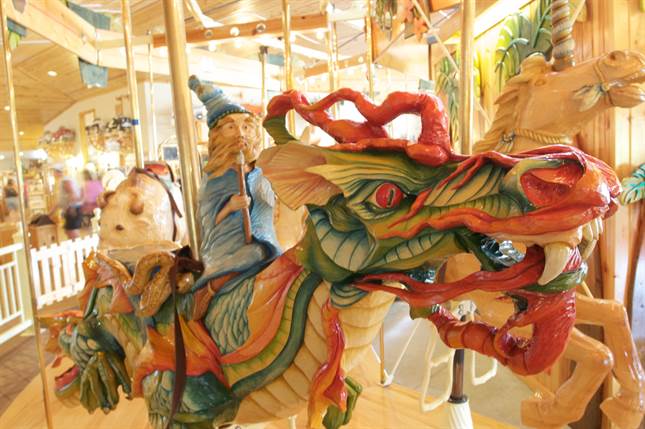
The closest I ever came to developing an esoteric interest was when I fell in love with a hand-carved carousel built a century ago. I was smitten to the point of reading a lot of background knowledge about carousels. It is a topic I can talk about at length. But in the end, I could not work up enough interest to become an expert about all the various makers of carousels in the country. A true lover of carousels would be fascinated by obscure little carousels that just look garish and cheap to me. My deepest affections were for one splendid carousel, not the whole category.

This comes to mind because my daughter is in the early stage of becoming immersed in a new interest for our family: ship watching. My son-in-law grew up in a lovely old home on the US bank of the St. Clair River. The St. Clair is deep enough to host the biggest ships sailing the Great Lakes. The river is, in fact, the only connection between the upper lakes (Superior and Michigan) and lower lakes. Any ship traveling far in the Great Lakes must pass close to John’s home, “close” meaning about a hundred yards. Now that our family lives in Port Huron, Molly has become fascinated with the ships we see here.

The photo heading this column is one I took in late September. The ship is the Federal Seto, a particularly lengthy “saltie.” It is owned by a shipping company based in Montreal. Since I took its portrait the Federal Seto steamed through Lake St. Clair, passed through Lake Erie, and then through Lake Ontario. After running the length of the St. Lawrence Seaway, today the ship has just entered the Atlantic Ocean on its way Rouen, France.

The major distinction between different bulk freighters on the Great Lakes is between “salties” and “lakers.” Salties are shorter than lakers and have higher sides. They move freely from lake to lake but also across oceans. Lakers, many of which are about a thousand feet long, cannot fit in the locks that connect the Atlantic Ocean with the Great Lakes. They work hard but always within the Great Lakes. In addition to being shorter and taller than lakers, salties are younger. The salty water of oceans is extremely corrosive, so salties rarely live longer than 20 years. By contrast, because lakers are not subjected to all that salt they can live many decades, even longer than a century.

Ship watching is popular hobby in this area, and there are many resources. Web sites track the movements of these ships. Many museums educate visitors about the shipping trade. There are books on ship watching, and newsletters. If you want to know the precise location and sailing plans for individual ships, “there is an app” for that. There are, in fact, several apps for smart phones that track these majestic ships at all times.

I was surprised by my daughter’s surge of interest in shipping. She has always had an active mind, but this is the first time she has immersed herself in a topic like this. Molly knows a great deal about Great Lakes ship traffic. She has favorite boats that she tracks with interest. She is highly excited by the fact a new ship being built in Europe will soon join the fleets of freighters already working the Great Lakes, and she will be sure to be on the porch of her mother-in-law’s home the first time it travels the St. Clair River.

Have you ever developed a fascination with an esoteric topic?

Packing

We are traveling by van for the next 10 days. We are going to a play therapy conference in Minneapolis.  As we can’t bear to let produce spoil, we are taking along our canning equipment, jars, rings, lids, and boxes of ripening tomatoes.  We must be out of our minds.

How do you pack for a trip?


In Search of My Irish

Today’s post comes to us from Jacque.

By the time you read this, I will be in Ireland. I could not get my head around how to tell one of these stories. It is cruel and overwhelming and unbelievable. It stopped me cold when I started to write it.

The group I am travelling with is a group of polymer clay artists who have been the students of our teacher from Jordan, MN, Maureen Carlson. She has for years had a teaching studio where people came to learn from all over the world.  One of those students is an Irish priest Father John.  Maureen closed her studio nearly 2 years ago to semi-retire.  He cut a deal with Maureen—let me come over for lessons one more time, and then the next year you can bring a group to the retreat center I run in Ireland for another 5 day lesson.  She said SOLD!  I was invited to attend.  I said yes.

Weirdly, this retreat center is located in the Irish county where my ancestors emigrated from in 1841 to Canada, County Down. That is my mother’s side.  You can the read the story of my great grandfather at this link:

https://www.bookemon.com/book_read_flip.php?book_id=278253

That story is stereotypical. The Newells wanted a better life.  They emigrated to Canada, then Iowa to homestead and did very well.  I hope to travel to see the old stone house the Newells lived in on the sea.  It is still there, 25 miles from the retreat center

The story I found in Ancestry.com on my father’s side knocked my socks off. I had no idea.  This is located in the county north of Down, in Antrim where Belfast is located.  I understand the Irish hatred of British after this one.  Sorry this is so long.  Here we go:

“The year was 1548 and it was in Ireland and it was time to pay Taxes to England . Ever year England would send a small army of tax collectors to Ireland to collect taxes, The people of Ireland had very little money and never enough to pay taxes to England . The tax collectors had been given the right from their King Edward V to take any thing of value to pay the taxes owed. It was the practice of King Edward and Mary Tudor to take Children in payment of the taxes. The children were taken to England to be trained as domestic servants and bonded labors.

This small village called Antrim, in the Ulster Province and of the MacDonald Clan was no different than any other village in Ireland everyone had to pay taxes one way or another, And this is where my story begins, Young children ages 12 years and older that looked in good health were taken from the family clans as payment for the taxes.From the time that the tax collectors picked the first children until they had over 100 children to go back to England it would take lest a week to 10 days. The children would be put into carts and wagons and most of the time their hands were tied to the racks on the carts to keep them from running away.

One young boy that came from Antrim was called James Antrim. His last name was from where he came from. He was being trained as a cord winder and rope maker. James Antrim was a hard worker and he learned well he also learned to read and write that would help him to get ahead in life. He lived and took his training at the family mansion of Sir Thomas Wyatt . During the five years of training young James Antrim had a hard time at first until his hands and arms got stronger, then he was as good a rope maker as there was.

It was on a spring day on a weekend that James went to the market with three men that he came to see for the first time a young lass with red hair , James had to know more about this young women. James found out that she was a cook’s helper at this master’s house and that her name was Colleen O’Shay . This was the first time that he seen his wife to be. The servant’s Masters was willing to let their servants have relationship with other household master’s  servants.  With the hopes that it would lead to a marriage. This way the servants children would be under the master ‘s care and they would become servants also and it would be cheaper than going to Ireland and bringing back young children to train .

Our ancestors were two of these servants that were married and two of their children came to Salem , Massachusetts, America in 1635. they were Thomas Antram and his wife Jane Batter, . And Thomas sent two of his sons John and James back to England in 1679 to bring friends and to raise funds to buy land in New Jersey. Our Ancestors were early America Pioneers.”

I hope that in our 5 days of touring we get to the Antrim area, as well. I want to know more about this practice of taking children for taxes.  It is guaranteed to create hard feelings that last for hundreds of years. It makes me think about how much I hate taxes sometimes.  Several times, while I owned my practice, I had to reach down deep to pay my taxes, but never did I have to make this kind of sacrifice—a 12 year old child.  I cannot come up with a question for discussion for this one.

What would you suggest as a question?

State Fair 2017

As you all know, I adore the Minnesota State Fair. This year I was able to attend three times: opening day on my own and twice with Young Adult.  Some new things this year: a thorough exploration of the West End area, Macaroni & Cheese Curds, llamas and alpacas in the very back of the horse barn.  And the traditionals as well: Hawaiian Shave ice, bunny whispering, butter heads.  After three years of lusting after them, YA and I caved this year and purchased a big set of Thin Bins, collapsible containers with color-coded lids. We also went home with some t-shirts, assorted bags and cookies.

Even though it is essentially the same parade day after day, it is one of my favorite parts of the fair. I love seeing the different marching bands, the dairy princesses and the art cars.

On reflection though, one of my favorite things about the Fair is the people watching – and the unbelievable “variety” there is in the folks of Minnesota (and Iowa/Wisconsin/Dakota visitors). Lots of different family types, from extended families in matching shirts to young families with their jam-packed strollers.  An amazing array of clothing and shoes – why would you wear bright white tennies to the fair?  Or high-heeled shoes?  Lots of shoppers (YA and I included) getting fancy scissors, wine pouches, shark teeth – this list could go on and on.

So now the fair is finished for another year and I’m already looking forward to next year. If my feet and my pocket book can handle it, maybe I’ll go four times!

Where is your favorite people-watching locale?