Category Archives: Words

Reading Mystery

A few years ago, back when a librarian needed to check out your books for you, the older red-haired librarian at the desk (Anna would know her name) said “My, you have a wide set of topics here.” I don’t remember what I was checking out, but I do read across a fairly wide swath.  Science fiction, fiction, mystery, a variety of science, biography, history, philosophy, fantasy, kid lit, thrillers.  About the only thing I don’t read is romance if I can help it.

It was about that time that I started keeping track of how I got the idea to read a particular book. I have several categories for this – my book clubs, BookPage from the library, Writer’s Almanac, my various “lists” (English Monarchs, Presidents, Newbury & Caldecott winners, etc.) and the Trail. By far the biggest category is O&A (Out & About), a catch-all for everything else.

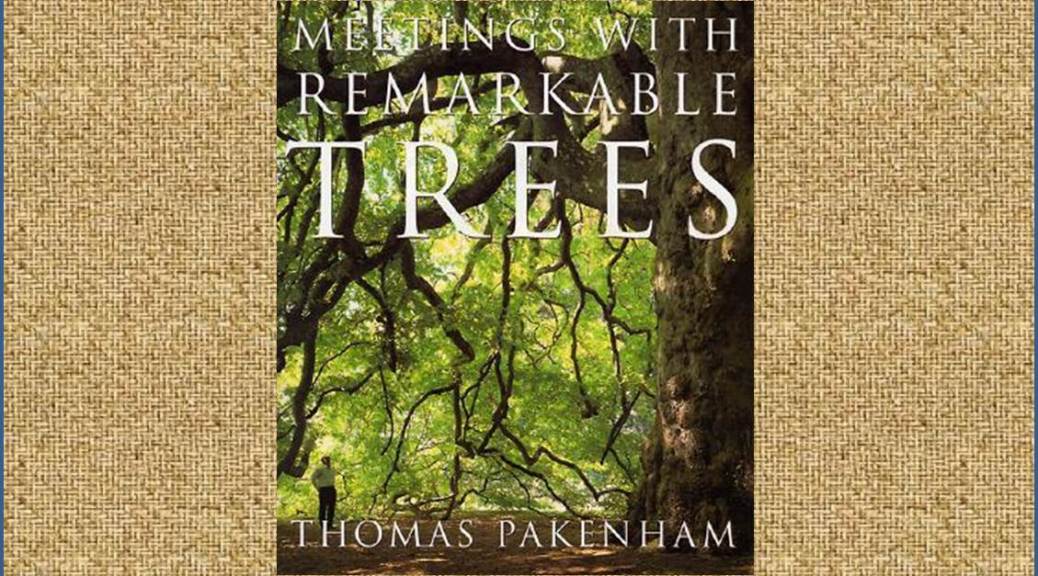
I’m pretty good at remembering where I find a title that I want to read, but every now and then I am surprised when I go to my hold shelf in the library. I knew from looking at my online account that there was an InterLibrary Loan titled Meetings with Remarkable Trees waiting for me.  It had the sound of poetry and many of the poetry books I look for end up coming from other libraries: I assumed it was poetry.  So imagine my surprise it’s a lovely photo book with essays about specific trees.  It’s fascinating but I’m not sure where the idea came from?  It’s not exactly the kind of thing that you find in the mainstream.

So I’ve decided it must be something that was recommended to me on the Trail. It’s about nature, so it might be Clyde (he is usually my go-to for travel books, but it seems like something he might like).  But it has absolutely lovely nature photos, so it might be the kind of thing recommended by Steve or Cynthia or BiR.  It’s a little off the beaten path, which has Bill written all over it.  The author is originally from Ireland, which means that it might have been recommended by PJ, who has a broader range of non-American authors.  I’ve haven’t gone back to the Trail and done a search: for now it’s a nice little mystery.

Do you do well at taking advice? Or do you prefer to GIVE advice?

Serial Bliss

Today’s post comes to us from Minnesota Steve.

There aren’t many things better than discovering a great book, a book so good you hate to turn the last pages because you never want it to end. One thing that is better is discovering that the great book you just finished is one in a series written by the same author. The pleasure you are feeling is repeatable.

One afternoon when I was about ten I discovered a book of stories by Arthur Conan Doyle in the Ames Public Library. The first of them, “A Scandal in Bohemia,” introduced me to the complicated figure of Sherlock Holmes and to the thrill of reading mysteries. When I understood there were more Holmes stories, I couldn’t believe my good fortune.

There is a lot to like about book series. You can start subsequent books in the series knowing you like that author’s style. You often go into subsequent books already knowing some of the characters and the setting. Series offer writers the chance to develop themes in depth and do a better job of telling stories. When I begin a book by a new author I don’t know if I will eventually feel the time I spent with the book will be rewarded. When you are chewing your way through a good series, that isn’t an issue.

I’ve just begun exploring a new series. Following exhortations from my daughter, I just read the first novel in Louise Penny’s beloved Three Pines series. Penny’s crime novels feature charming Canadian locales and the comforting presence of Chief Inspector Armand Gamache. Louise Penny has a warm and whimsical view of life and people. While her novels are driven by the need to explain a murder, the people who fill her books are human and mostly likable. Penny’s vision is deeply rooted in community. My daughter enjoys Penny’s humor. I was surprised to find so many “Easter eggs” in the form of unexpected observations about life and people. The series currently includes 15 books. Penny adds about a book a year. When my daughter met Louise Penny last year at a Detroit book signing event, she was not surprised to find Penny is modest, witty and gracious . . . just the sort of person who would write such appealing novels.

I’ll have more to say about good book series in the Comments section.

What book series have you enjoyed? What did you like about them?

Words for Book Lovers

I get an email every day from Dictionary.com with a “Word of the Day”. Then on Mondays there is a quiz of the last seven days worth of words.  And occasionally there are other emails about word-related things.  Last week there was an email with a link to “Words All Book Lovers Should be Using”.  You know I can’t resist that.

Here are the words.

  • bookish
  • colophon
  • bibliotaph
  • fascicle
  • logophile
  • sesquipedalian
  • bibliophile

How many of them do you know? How many of them describe YOU?  Any other words you think all book lover should be using?

Dilemna or Dilemma?

In helping YA proofread an essay last night, I noticed that “dilemma” was not underlined as misspelled. When I corrected it to “dilemna”, I got the squiggly red line saying it was now incorrect.

The internet tells me that I am not alone in believing that “dilemna” is how it should be spelled. In fact, the internet also tells me that the majority of English speakers over 40 worldwide, believe that “dilemna” is correct, being taught that spelling in school.

The revered OED doesn’t even list “dilemna” as a variant, although the misspelling can be found as far back as 1551 (Wilson’s Rule of Reason) and even in Robinson Crusoe by Daniel Defoe.

So here I am, after 50+ years, trying to figure out a way to remember the correct spelling. Maybe I’ll just come up with a good synonym instead!

What new tricks have you had to learn lately?

Literary Bust

As I was reading this morning (Career of Evil by Robert Galbraith [aka JK Rowlings]), the narrator casually mentions watching a show about art and the camera pans the room, to include a bust of Beethoven.  There is a smidge of discussion about how the protagonist looks a bit like Beethoven and then the story moves on.

But as the story continued, I was distracted by the thought of the Beethoven bust. Hadn’t a bust of Beethoven just been a book I finished last week?  And wasn’t there a bust of Beethoven in a book I read a couple of months ago.  Time to backtrack in my reading history.

There was indeed a bust of Beethoven in Transcription by Kate Atkinson.  It was included in a description of a room and then later was used by a Nazi sympathizer to try to escape from the MI5 agents who had uncovered her treachery.

The previous literary bust turned out to be Baudelaire, not Beethoven, in The Alice Network by Kate Quinn.  In that book, the Nazi (yeah, I know you ‘ve all heard me say I’m sick of WWII books, but apparently not that sick) uses a bust of Baudelaire to break the fingers of the young spy.  Gruesome.

I have no idea what this means to the larger world, that busts of Beethoven and Baudelaire have shown up repeatedly in my reading the last few months, but it’s fascinating to me.

Pick a bust for your living room… any composer, artist, writer or super hero. Living or dead.  Who is it?

If You’re Going to Blow it, Blow it BIG!

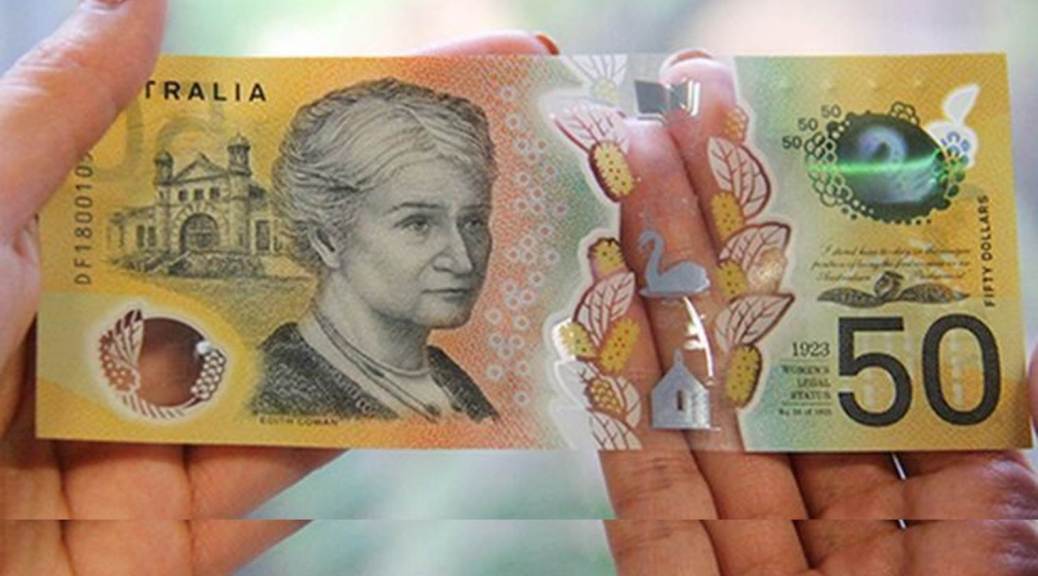
Photo Credit: Reserve Bank of Australia

As part of my job, I send out communications to travelers all the time. Most of our communications are proofed by four or five people, more if the client actually reads the copy.  Every now and then we find a typo after something has gone to print and we tend to say the same thing “How can so many people look at something and not see the error?”

Well now the Reserve Bank of Australia is asking this same thing. Their new £50 note with Edith Cohen (first woman member of the Australian parliament) has a typo.  In teeny tiny letters, as part of the background, the note says repeatedly “It is a great responsibilty to be the only woman here and I want to emphasize the necessity which exists for other women being here.”  Missing an “I” in the word responsibility.  46 MILLION of these notes are now in use around the country.  Wow – when I mess up, it usually only has an impact on 100 folks or so.

Australia says they won’t recall the notes but will correct the mistake when they print the next batch of £50 notes. This makes me wonder if folks will hang onto the notes as a curiosity that won’t be repeated, like that rare Beanie Baby or Geordi Laforge action figure without a visor.

Do you collect anything?

Redeeming Science

I swear more than I like; as a child I fully succumbed to my father’s theory that people who swore just didn’t have good enough imaginations to choose better words.  But I am, in the heat of the moment, a potty mouth.  I’ve always kind of wished that I were a sailor; as I understand that sailors and longshoremen are the best swearers . Then maybe I’d have a bigger swearing vocabulary and wouldn’t need to feel my father’s disapproval from the great beyond.

So lo and behold, I see online today (SciShow) that it turns out that swearing can confer stress release, pain amelioration and increased social bonding.  This backs up a Mythbusters episode I saw a few years back in which they tested pain response (iced water) in volunteers who either had to stay silent or could swear to their heart’s content.  The swearers were able to hold their hands in the iced water longer and recorded a less intense level of pain.

Apparently the social bonding is based on the perception that you are more open/forthright if you swear, as opposed to “holding something back” by not swearing occasionally.  There is apparently science to back this up along with the stress relief aspect of swearing as well.

I don’t know if having this knowledge will make me swear more or if I will always hear my father’s voice in the back of my head.

What bad habit would you have that you’d like to be redeemed by science?

The Cruelest Month

In an email this week, Renee said to me “April is the cruelest month”. I disagree (because, of course February is the cruelest month) but it made me think about assigning human characteristics to the months.  Or days (Monday’s child is full of grace….).  Or anything non-human.

I tend to appreciate this – I supposed because it’s a version of metaphor and I love metaphor. Here is one of my favorite passages in which the non-living becomes living (from Betty MacDonald’s The Egg and I)”

“Town” was the local Saturday Mecca. A barren old maid of a place, aged and weathered by all the prevailing winds and shunned by prosperity. Years ago the Town with her rich dot of timber and her beautiful harbor was voted Miss Pacific Northwest of 1892 and became betrothed to a large railroad. Her happy founders immediately got busy and whipped up a trousseau of three-and four-story brick buildings, a huge and elaborate red stone courthouse, and sites and plans for enough industries to start her on a brilliant career.

Meanwhile all her inhabitants were industriously tatting themselves up large, befurbelowed Victorian houses in honor of the approaching wedding. Unfortunately almost on the eve of the ceremony the Town in one of her frequent fits of temper lashed her harbor to a froth, tossed a passing freighter up onto her main thorofare and planted seeds of doubt in the mind of her fiancé. Further investigation revealed that, in addition to her treacherous temper, she was raked by winds day and night, year in and year out, and had little available water. In the ensuing panic of 1893, her railroad lover dropped her like a hot potato and within a year or so was paying serious court to several more promising coast towns.

Poor little Town never recovered from the blow. She pulled down her blinds, pulled up her welcome mat and gave herself over to sorrow. Her main street became a dreary thing of empty buildings, pocked by falling bricks and tenanted only by rats and the wind. Her downtown street ends, instead of flourishing waterfront industries, gave birth to exquisite little swamps which changed from chartreuse to crimson to hazy purple with the seasons. Her hills, shorn of their youthful timber in preparation for a thriving residential district, lost their bloom and grew a covering of short crunchy grass which was always dry and always yellow—lemon in spring, golden in summer and fall. She wore her massive courthouse like an enormous brooch on a delicate bosom and the faded and peeling wedding houses grew clumsy and heavy with shrubbery and disappointment.

I also love commercials that depict non-human objects as having personalities. I really liked the Jimmy Dean sun commercials:

Did you ever name your stuffed animals as a child?

Saying “No”

I have a hard time saying “no, I can’t do that”.  I tell the intake people at my work that my schedule is too full to take on new clients, and then I get a phone call from our county social services that they have five children who need therapy, and I am the only one in the area who sees children as young as the ones they are referring, and guess what? I have five new appointments for next week. People at work just laugh at me when I tell them I am going to put my foot down and not take any new clients. I have no one to blame but myself.

Is it hard for you say “no”?  How do you manage to do it if you are able?  What is hard for you to communicate to others?  What is your favorite scene or song from Rogers and Hammerstein?


Libraries – A Love Fest

Yesterday was the anniversary of the opening of the first free public library, the Peterborough Town Library in 1833. The decision to purchase books and open a tax-funded library happened at the Town meeting and for the first sixty years, the books were housed in the general store.  In 1893 they were moved to the current location and there have been two expansions since then.

Here are a few fun library quotes:

“Well-run libraries are filled with people because what a good library offers cannot be easily found elsewhere: an indoor public space in which you do not have to buy anything in order to stay.”  Zadie Smith

“The only thing that you absolutely have to know, is the location of the library.” Albert Einstein

“Libraries: The medicine chest of the soul.” Library at Thebes, inscription over the door

“My two favorite things in life are libraries and bicycles. They both move people forward without wasting anything. The perfect day: riding a bike to the library.” Peter Golkin

“I have always imaged that Paradise will be a kind of library.” Jorge Luis Borges

I’m a complete library junkie. One of the biggest selling points when I bought my house was that it was a block and a half from the Washburn Library.  On the average week I am there twice.  I know the hours by heart, am friendly with the librarians.  I even have my library card number memorized.  Twice I’ve had the opportunity to spend an afternoon in the Central downtown library in the upstairs reading rooms – times when I wanted to read resource material that they don’t allow you to check-out.  It was warm and wonderful; so relaxing that I wasn’t sure I wanted to leave at the end of the day.

Tell me about your favorite library memory?