The Peanut Butter Conundrum

Today’s post comes from Sherrilee.

My father wasn’t as funny as he thought he was.  Don’t get me wrong; he had a lot of wonderful qualities.  He was kind, thoughtful, intelligent, generous.  But Billy Crystal he wasn’t.

When I was a teenager, he would answer any call that came in after 8 p.m. with “Joe’s Morgue.  You stab `em, we slab `em.”  He thought this was endlessly funny.  My sister and I ended up getting our own phone.

I was thinking of him tonight when I opened a new jar of peanut butter.  When I was growing up, if you scooped out the first peanut butter from the center, he’d gasp “Oh, no, you took it from the center!”  Of course if the next time you scooped from the right side, he’d throw up his hands in mock-horror and say “Oh no, you took it from the wrong side.”  Then when you chose the other side… you guessed it, “Oh no, you didn’t take it from the middle!”  Every jar.  Every single jar.

He’s been gone for 13 years and while I’ve always missed him, it wasn’t until tonight that I realize I even miss his stupid peanut butter joke.

I scooped the peanut right out of the middle!

Who’s the funny one in your family?

Good Year For Earworms

Today’s guest post is from Linda in St. Paul (West Side).

The Germans have a word for it – ohrwurm, which translates literally as earworm, that phenomenon of getting a song lodged in your head that plays over and over till it drives you to distraction. I fall victim on a regular basis. Often particular songs are triggered by everyday objects or activities, and this is never more true than when I’m working in a garden.

I can’t trim a rosebush without drifting into It’s Been a Good Year For the Roses. It’s usually the George Jones version, though it occasionally morphs briefly into Elvis Costello.

Tending a bittersweet vine is a sure way to conjure Big Head Todd and the Monsters. (“Bittersweet…more sweet than bitter…bitter than sweet…”)  If you don’t know it, you could look it up on YouTube. Consider yourself warned, though – it’s a sticky one, as difficult to dislodge as a ball of burdock seeds.

Buttercups invariably trigger All Shook Up. I explained this to a friend once and she told me I am lucky my mental jukebox goes to Elvis instead of The Foundations.

An especially virulent earworm is Don’t Sit Under the Apple Tree with Anyone Else But Me. I cannot even walk past an apple tree without suffering an acute attack.

And then sometimes my brain takes an odd detour and arrives at destination I’m at a loss to explain. I spend a couple of weeks in the summer pulling a vine known as hog peanut. To my knowledge, no one has ever written a song about hog peanut. The song that surfaces from my subconscious to fill the void is the bebop classic Salt Peanuts, with the lyrics adapted: “Hog peanut…hog peanut…” in an endless loop. Can you hear it?

Winter is fast approaching, and the garden earworms will sleep beneath the snow for a few months, to return in the spring. The only thing I have to say is…it’s been a good year for the roses.

Share your favorite (or least favorite) earworms.

The Back 40 Boneyard

In a southern Michigan soybean field, a farmer found a bent fence post, caked with mud.  Which was no big deal, until he discovered it was actually part of a fifteen thousand year old pelvis of a Wooly Mammoth.

Wooly Mammoths, which are extinct, seem rather exotic for southern Michigan. Though the news accounts carried no suggestion that the farmer felt annoyed by this unexpected find, it had to be a pain in the butt to halt daily agricultural operations to bring in the archaeologists.

But Trail Baboon’s singsong poet laureate, Schuyler Tyler Wyler, became quite excited when I told him about this story, because he considers the Wooly Mammoth to be his totem animal.

Both STW and Wooly Mammoths are large, hairy, under-appreciated creatures whose unexpected appearance can sometimes lead to feelings of disappointment that the discoverer has not found a real elephant, or a serious poet.

STW’s latest work speaks of this in the hirsute behemoth’s lilting voice.

A farmer works for higher yields,
to see his family’s bread won.
But gets my carcass in his fields!
A crop!  Alas, a dead one.

My bones are no commodity
to trade on the exchange,
An old organic oddity.
low-salt, no cage, free-range.

To dig me up is more than play.
I’m ingrained in the ground.
Though true, I’m trespassing today,
‘Twas not when I fell down.

So now they’ve dug up my remains,
and inventoried fully:
Acres of soybeans, tons of grains.
One ancient Mammoth, wooly.

But I’ll make no apology
to that exhausted farmer.
His harvest – part mythology,
part prehistoric charmer!

Ever find a surprise in the dirt?

Board Meetings

Header photo by Sammydavisdog on Flickr via Creative Commons 2.0

Today’s post comes from Barbara in Robbinsdale.

I have recently joined the Board of Directors at Tapestry Folkdance Center. It is a three-year term, and I thought long and hard about this commitment that I have been avoiding for some time. With good reason – I am now on two committees, and feel like I must show up when there is, say, a seasonal Clean-up Day.

Some of our discussion topics seem very crucial (fund raising; how to get and retain new dancers), but then I looked at what was discussed at the G-20 Summit talks happened on November 15 and 16 in Antalya, Turkey. Here is one article providing a recap of all that was on the agenda:

  • Bolstering counterterrorism efforts
  • Responsible state behavior in cyberspace
  • Achieving strong, sustainable, and balanced global economic growth
  • Making global growth more inclusive
  • Addressing the global refugee crisis
  • Promoting high-standard trade and investment
  • Strengthening the global financial system
  • A modern, fair international tax system
  • Fighting corruption and promoting transparency
  • Supporting sustainable development
  • Addressing climate change and boosting clean energy

I’m trying to imagine covering these topics in two days. They must have had a really strict time “moderator”.

And for a little comic relief, there was a cat invasion:

Where do you find comic relief during a long meeting?


Calving Laws

A very thorough article in the New York Times about the collapse of Greenland’s Ice Sheet was less than precise about the timeline for rising ocean levels.   Melting on this scale is unprecedented in human history.  University of California – Irvine professor Eric Rignot was quoted saying ‘‘‘We’ve never seen it. No human has ever seen it.’’

The problem is made worse by the fact that ice is complicated.

“Glaciologists remain vexed, for instance, by the physics of how ice cleaves off the edge of the sheet. As Rignot told me, ‘‘We don’t have a set of mathematical rules to put in a numerical model to tell you how fast a glacier breaks into icebergs.’’ He emphasized that discovering these rules, known as calving laws, could be all-­important. Richard Alley, a glaciologist at Penn State, told me: ‘‘Problems that deal with fracture mechanics — volcanic eruptions, or earthquakes, or things that involve the question ‘Will it break or not?’ — tend to be difficult. You ask, Will the ice shelf break off a lot or a little bit? Will the cliff left behind crumble? Will it crumble fast? Will it crumble slow?’’ So far, Alley says, we can’t be sure. But a formula might tell us in advance how fast the ice sheets might crash into the sea.”

After I told Trail Baboon’s sing-song poet laureate Tyler Schuyler Wyler about this unfortunate gap in scientific understanding of the effects of climate change, he immediately warmed to the idea of taking it on as an artistic challenge.

The great glaciers up in Greenland look serene and sharp and still.
But they’re melting at the speed at which great glaciers often will.

If you want to know how fast that is I’ll share this helpful clue:
Mammoth  ice chunks liquefy as quickly as they’re wont to do,

They will crack and pop and shift and drain from bottom to the top.
Getting worse exactly at the rate that ice shelves go “ker-plop,”

when they drop into the ocean with sufficient force to flatten,
and to cause enough displacement to submerge lower Manhattan.

To assess the speed precisely you can do this computation –
Take the age of your old Buick times the planet’s population

Then subtract the number of bike trips you took to work last May
from the setting on your thermostat on any average day.

Then divide this by how often you drive to the corner store
plus how long you let it idle while you run back in for more.

Add that number to the time it takes to soak in a hot tub
and you’ll know how quickly glaciers melt!

Glub glub, glub glub.

Glub Glub.

Where’s your favorite spot to view the ocean?

The Stuff that Dreams are Made Of

Today’s post comes from Renee in North Dakota

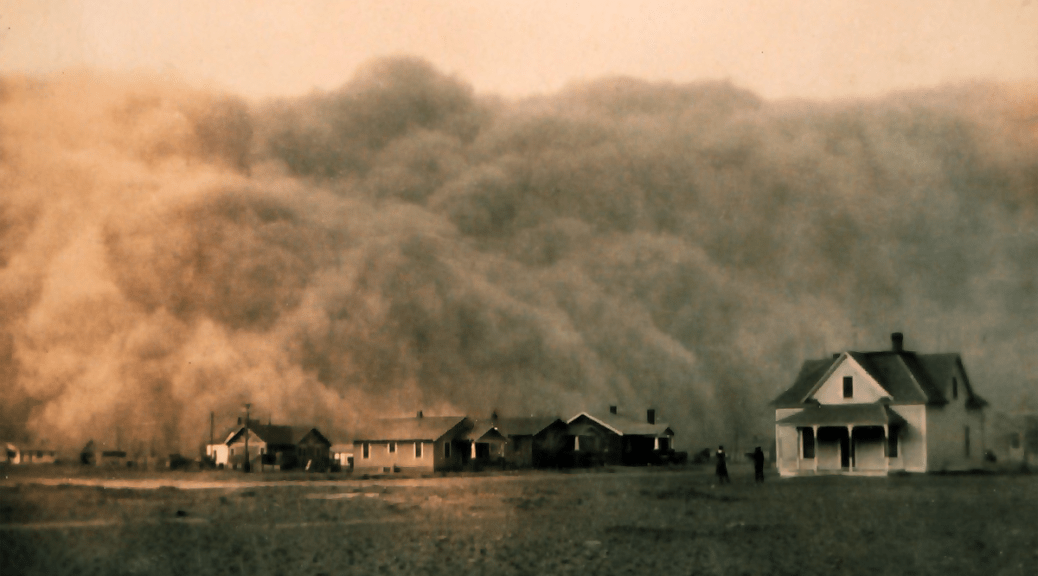
I am not much into dream interpretation, being a Dust-bowl empiricist sort of psychologist by training. My dreams are pretty understandable, not scary, just annoying and mundane, usually fueled by anxiety. My most recent stupid dream concerned the band in which husband and I play doing a gig at the Vatican, and I couldn’t get my bass guitar amp to play loud enough during Mass. How dumb is that?

Our sojourn into Indian Country has taught me, though, that when a person has a dream concerning American Indians, it is wise to sit up and take notice. Dreams are important means of communication in the Native community.  I have heard many a Native person say to someone “I had a dream about you last night. Thought I better come and check if you are ok.” I had a very strange dream a while back about Linda, one of our Native friends we were going to meet up with at a pow wow. The dream, which seemed strangely real, involved Linda, in great distress, trying to contact me to tell me that she wasn’t going to make it to the pow wow because she was ill.  In the morning we drove up to the pow wow grounds. I asked about Linda and was told that she was ill and was staying home. That was a really odd experience.

image003 (1)

The photo attached to this post is of the Hopi Corn God.  We purchased him at Mesa Verde, in the National Park gift shop. He isn’t made by the Hopi, but by Apaches for the tourist trade. I think that Kachinas are too sacred to the Hopi to make and sell. I set him in a place of honor in the living room when we got back home. One night I had enough of husband’s snoring (this was pre-CPAP) and I bunked up on the living room sofa. That night I had a horrific dream that the kachina was really, really angry. It seemed very real, and it was again hard for me to decide if it was a dream or if it was really happening.  He was about 50 feet tall and was moving toward me, stomping and stomping with his big feet.  It felt that he was going to stomp me to jelly. I woke up and found some dried field corn we had for the squirrels and sprinkled some around the kachina’s feet.  I haven’t had any more dreams about him, but I wonder what it was he was trying to tell me that night.  Probably that even Apache-made Hopi Kachinas are too sacred to be used as an ornament. I probably need to ask some our Native friends what I should do with him and how I should properly dispose of him if they think that necessary. Be careful if you have an opportunity to purchase Native artifacts.

You may have dreams.

What is your most worrisome artifact?

Adventures in Poo

Today’s post comes from Ben.

When we first had children Kelly and I made an agreement: She’d take care of the poop and I’d take care of the vomit.

Course that doesn’t always work, but when it does it was great. She didn’t like vomit and I didn’t like poop.

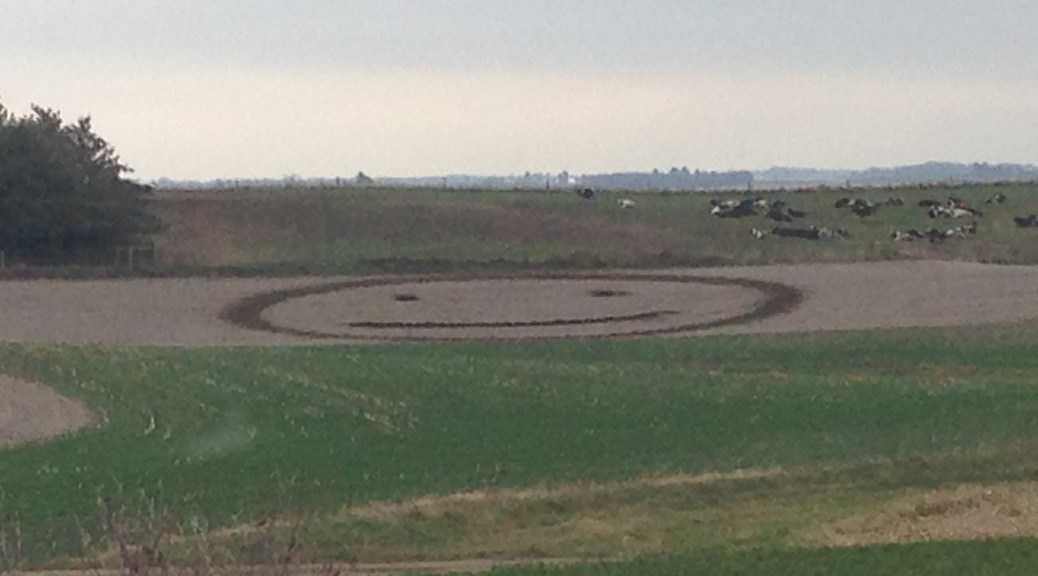
Driving to Plainview today I saw this:

Poo smiley face

If you can’t tell, it’s made with manure. And it’s harder than you think to make that. (The face, not the manure).

I think he had to make the mouth and eyes first and then go around the outside making the circle. Otherwise there’d be tracks back out.

So is this art? Yeah, I think so.

And it got me thinking about my dealings with manure.

Any time you work with large animals you are going to be splattered, smacked and smeared with poop at some point in time.

I’ve been hit in with face with poopy tails. I’ve had my hands in it to fix things.

In the winter with the cows in the barn most of the day, we had to clean the gutters every morning. Dad did it by hand using a wheelbarrow and running up a 2” x 12” ramp to dump it in the manure spreader. If it was raining, It was slippery and you had to be more careful. I wasn’t always.

I was just getting old enough to handle the wheelbarrow when he put a barn cleaner in. So now It was easy. As long as it worked.

In the winter we always checked to be sure the chain wasn’t frozen down before starting it up. Because fixing a broken link involved forking out a lot of manure to get the chain back together. And hopefully I HAD the replacement link.

Being cold, it was a good idea to check the apron of the manure spreader before

you loaded it up with manure. Because fixing that was a hassle too.

One of our family stories is the year my dad had bunions cut off both feet. He had this done in the middle of winter figuring it was the best time to do it. Yeah, for HIM. Not for us doing chores. We had arranged for a guy to do the milking and chores while Dad was recuperating in the wheel chair.

The guy didn’t last long however and his last day was a cold dark day and he broke the manure spreader apron chain with the spreader still half full and he simply parked the spreader back in the shed and went home.

Mom and I had to fork off the rest of the load and then we lay under the spreader trying to fix the chain while dad yelled instructions to us from the Living room window.

However many weeks into recovery dad was, he was back in the barn the next day with bread bags slipped over the casts on his feet.

Below zero days I had a few simple goals; no broken water pipes, the silo unloaders worked, the tractor started and I got the barn cleaned and the spreader unloaded without issues. If that all worked it was a good day.

As for home and kids and poop and vomit… I don’t remember so much about that. I know there were messy diapers. I know there was vomit. I remember trying to catch it in my hands once or twice…

I myself remember throwing up in 5th grade. Went to the teachers desk and said ‘I don’t feel good; can I go to the nurse?’ and puking into his wastebasket right there. He jumped up, the class recoiled and I recall him saying ‘Go! Just Go!’

Team Vomit or Team Poo.  Which side are you on? 


The Dust Suckers

My apologies, Renee and Baboons.  I was away from e-mail and the blog all day yesterday, and did not realize there was no comment box in spite of several polite attempts made by diligent readers to call my attention to that fact.  

I blame the dust.  In my brain. 

Comments are now open on this post, which will remain up through the weekend. 

Today’s post comes from Renee in North Dakota.

Husband has terrible airborne allergies, particularly to dust and pollen and cat dander. I had hoped that when we installed new siding and windows in the house last year he would find some relief, at least inside the house, but it didn’t happen. We have HEPA filters running all the time and have dust mite proof mattress and pillow covers, and new carpets, but he still downs Sudafed and Allegra like candy and is always sneezing and clearing his throat.

I noticed that even when our new windows were shut tight, there was always a thick layer of dust on furniture and other surfaces. I know that it is dustier out here than in other places because of the winds we have, but, honestly, a person shouldn’t  have to dust twice a week when the windows haven’t even been opened.

It occurred to me that we must be recirculating dust whenever we ran the furnace or the central air conditioning. I replace the furnace filter at the approved intervals, but that didn’t help, either. We decided to call in the dust suckers, or, more professionally, Peterson’s Furnace and Air Duct Cleaners. They arrived today and spent 7 hours removing more dirt and objects from our furnace and furnace ducts than I thought possible. They have a 600 lb vacuum that gets connected to the furnace and cleans out everything. The hose is more than a foot in diameter.  They also go from the vents back to the furnace to make sure nothing is in the ducts, and then sterilize the whole duct system. Some of the more interesting things they removed included:

    • Pieces of lumber, presumably left by the construction workers who built the house in 1978
    • Chunks of drywall-ditto
    • Cassette tapes
    • Cat toys
    • Spoons (not soup spoons but spoons for feeding babies)
    • gargantuan dust bunnies

Mr. Peterson is a local, and his able assistant is from New Jersey and has the most delightful accent. They tell us that this procedure should be done about every 10 years. It evidently hasn’t ever been done here in the 37 years since the house was built.  It remains to be seen if husband’s allergies will remit somewhat, but getting rid of the dust certainly can’t hurt. I need to ask my children which of them stuffed cassette number 4 of Harry Potter and The Goblet of FIre down the heat vent, and why. Alas, though, now I know that none of my missing soup spoons are in the duct work.

What long-missing item might be hiding in your air ducts? 


Finding the Sacred

Today’s post comes from Renee in North Dakota.

One thing I appreciate about the Baboons is our tolerance for one another’s opinions and beliefs. Oh, sure, we have our occasional tiff, with brief howling and hurling of poo, but after a bit we regroup and run happily together down the Trail to the next topic.

I have long wanted to post this, but hesitated, with the hesitation that many people have when discussing their religious beliefs. I know most Baboons are quite spiritual, some in less traditional ways, but spiritual and thoughtful. I have trust that the Baboon community will consider this in the spirit in which it is intended (which is to elicit comment and discussion).

I am privileged to be a member of a committee of the western ND Evangelical Lutheran Church in America that approves people who wish to become rostered leaders in the church. This means that if you want to be an ELCA pastor in western ND, you have to jump through a whole lot of hoops and have the qualities that we need for our clergy leaders. Anyone can go to seminary, but if you want to be called and ordained, you need our blessing. This means that we walk with  applicants for several years, attending to and encouraging their growth and maturation, even those who start the process later in life. Some start very later in life, but the process is still the same.

It always fascinates and moves me the first time we meet with an applicant. They are frequently teary. They have incredible faith stories and are so relieved to take the first step to answer what sometimes has been an internal urging that they have tried to ignore for years, but find that they cannot. Some have had incredible heartbreak and trauma, but persevere to answer what they hear as a direct call from God to serve the Church. After one particularly moving interview, a fellow member of the committee said to me “The Holy Spirit was in the room with us tonight”. That statement made the hair stand up on my neck, for I knew that she was right, and let me tell you, the thought of kind of makes me stop and feel humble.

After our June meeting last summer, I left Bismarck and travelled to the Twin Buttes Pow wow in Twin Buttes, ND. We have dear friends from Twin Buttes who are tribal members, and the Pow wow is always so much fun with them. I love watching the Grand Entrance and all the dancers in their gorgeous costumes and intricate dance steps. In the center of the Pow wow grounds is a pole that the dancers circle around, counter-clockwise. Our friend’s mom, now passed, had brain cancer for years, and her only request each year was to see the pole and get pushed up to the pole in her wheelchair so she could touch it. She was also a devout Christian, but that pole was also sacred to her.

It is fun to walk around the pow wow grounds to see the vendors, and the people. I notice children and adults tapping their feet to the rhythms of the drum circles, hearing the traditional songs, also sacred, and I am reminded that the sacred is all around us, in meeting rooms and on pow wow grounds, in churches and in our everyday encounters.

Where do you find the sacred in your life?

Remembering Them

Today’s post comes from Barbara in Robbinsdale.

November 11 has been called Veterans Day since 1954 – before that it was called Armistice Day in honor of the end of the hostilities of World War I. My story grew out of an event from World War II.

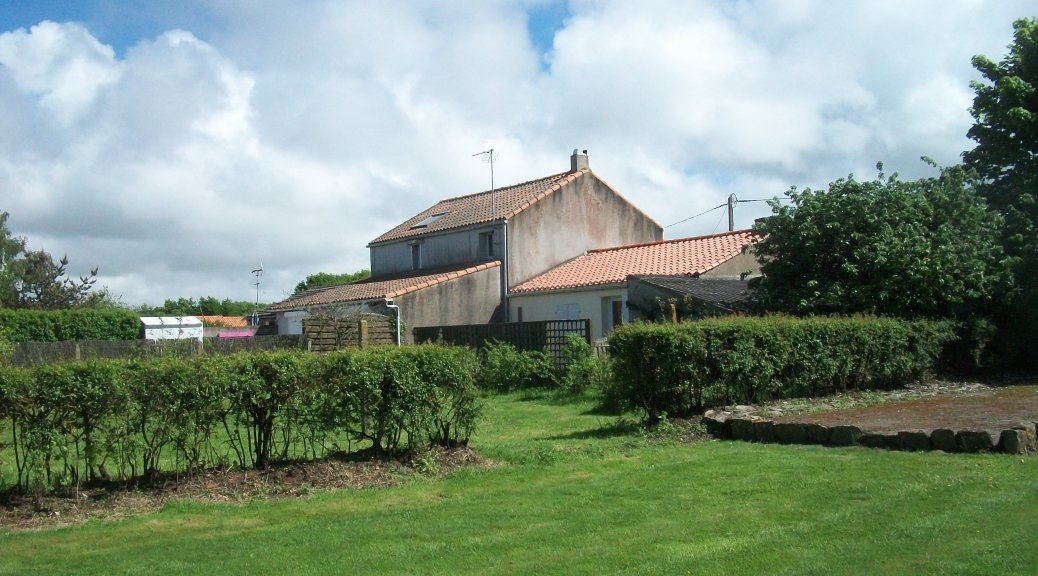
You would think they might still be mourning the French people they lost in World War II 70-odd years ago (and I’m sure they are). But in spring of this year, the French villagers of St. Père en Retz, on the western edge of the Loire region of France, wanted to honor the Americans who died there on May 1, 1943. A crew of ten from the US Air Force flew a B17 (the Black Swan) out of Britain, one of 59 bombers on a mission to take out a submarine bunker at coastal St. Nazaire that had been taken over by the Germans. Six lost their lives, including the pilot, who was my mom’s older brother Bobby (Jay Robert Sterling). (Another time I’ll tell more of what we now know of the story.)

The people of this region are still so grateful for every attempt by American and British forces to aid them, that between 2013 and 2015 five different villages along the Retz River have  commemorated the soldiers, with several more installations planned in the next few years.

The organizing Committee from St. Père en Retz searched via the internet for crewmen’s family members, then invited us to come to France for the occasion. They were fairly successful – eleven travelers representing four of the crew were able to gather the first weekend of May. (A fifth crewman’s family was able to come later on.) Since my mother wasn’t well enough to make this trip, my sister and I went in her place, along with her son and Husband.

Other family members of the crew had visited St. Père en Retz individually in previous decades, and had each been honored in some way. But this time they wanted as many people as possible as they accomplished several things:  installation of a new History Panel (Panneau Historique); upgrading a Monument listing the names of the crew;  and commemorating this with a church service, and ceremonies at the crash site, to which the entire village was invited.

Six of us were put up at a country manor house of one of the Committee, five more at nearby B & Bs. The villagers were impressed that we would travel all this way – we were impressed by all the work the Committee undertook to organize this, how they welcomed us, and the turnout of the community for the ceremonies.

So it was a weekend full of receptions, ceremonies, speeches, poems, banquets, unveiling of monuments, viewing of the crash site (the most emotional time of the weekend), and touring related sites like the submarine bunker. There was also consulting my LaRousse at every turn as I tried reviving my college French, attempting to remember all the new French names, and getting used to being full of food and wine all the time…  We were exhausted by Monday morning, but I wouldn’t give it up for anything. It was quite something to be celebrated like this.

All over this corner of France, these Panneau Historique are being created and installed, telling the stories they don’t want their people to forget.

Have you ever been moved by a patriotic event?
Is there anyone you want to remember this Veteran’s Day?