
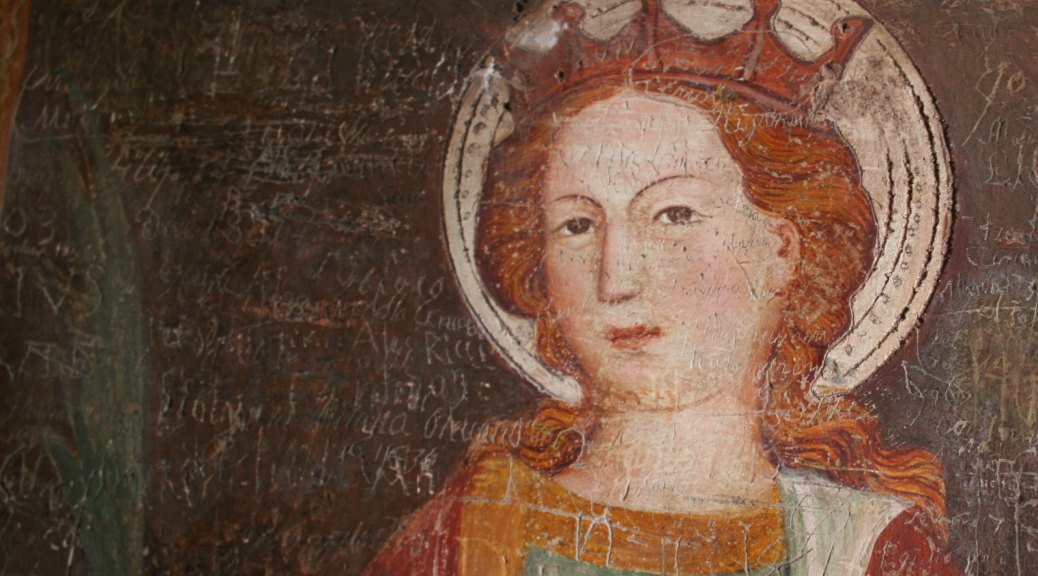
I really enjoy reading about the lives of the saints. I am fascinated by their histories, and I am also fascinated by the veneration of the saints by many Christians. Lawrence Durrell writes in his book The Greek Islands that he observed the Greeks to have an intensely personal relationship with their saints, often chastising them for not coming across with answers to prayers. He heard one person angrily refer to their saint as “that stinking old cuckold in the niche” after being particularly disappointed by him. I am Lutheran, a member of a church not typically associated with the saints. I understand, though, how important the saints are to many people, and how comforting and reassuring it is to know that someone who was human and not perfect but really, really special, has our interests at heart.
It is interesting to see references to the saints in modern day life. Unless you know about St. Apollonia, for example, you might not understand why the new dentist office in town is called Apollonia Dental Services.
Many of the saints died horrible and violent deaths for their faith. Many are exlemplars of Christian charity. Some saints are more difficult to fathom. St. Christina the Astonishing is one of the patron saints of mental health workers. Born in 1150, she was a rather alarming Belgian woman who died of a massive seizure at the age of 20, and arose out of her casket at her funeral and floated to the rafters of the church complaining that she couldn’t bear the smell of all the sinful people in the congregation. She went on to behave in very alarming ways until she died again at the age of 74. I don’t know if I would want her to intercede on my behalf. She was pretty odd. I would rather rely on Isidore of Seville, who wrote the first encyclopedia compiled in the post-classical world, and who probably knows a lot about everything there is to know.
Even if you are not a believer, who would you want to be your patron saint?


 [
[













 Trail Baboon